Companies
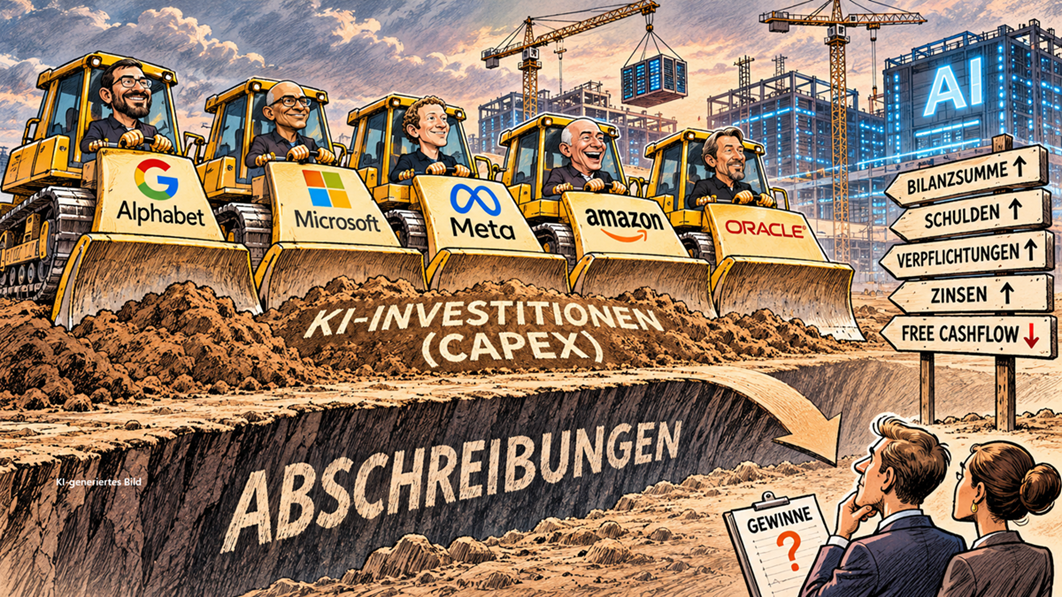
Talk is cheap; it’s what happens on the ground that counts. Thus, the trillion-scale investments in artificial intelligence (AI) are no longer mere announcements, but are rapidly transforming the balance sheets of the so-called hyperscalers – Alphabet, Amazon, Meta, Microsoft and Oracle.1 The five tech companies’ commitments to infrastructure investment are staggering and will be reflected in their balance sheets in the future.2
The five companies are referred to as ‘hyperscalers’ because they are investing far beyond the usual level, with the aim of scaling up future revenues from their AI-based business offerings; this is happening at a pace that was scarcely imaginable just a few years ago. What were once comparatively capital-light platform and software companies are now evolving into capital-intensive infrastructure operators that incur high fixed costs. The hyperscalers are therefore ‘the new heavy industry’ (Schürmann 2026).
This is also changing the perspective of their shareholders. Whereas the business models and success of these companies used to be based primarily on ‘soft factors’ such as the expertise and creativity of their staff, the question of whether investments in ‘hard fixed assets’ will pay off is increasingly taking centre stage. Companies must generate additional revenue from AI and use this to generate cash flows that cover – and, if possible, exceed – the significantly increased costs.
Whether they will succeed remains to be seen. For now, the hyperscalers are still sowing the seeds in the hope of a bountiful harvest. As the answer is still pending, it is essential to examine the hyperscalers’ respective balance sheets. These provide clear indications of future developments.
1. Unabated pace of investment
The latest quarterly reports show that the pace of AI infrastructure development remains undiminished. After the aggregate balance sheet total of the five companies rose within five years from just over 1.3 trillion dollars in the summer of 2021 to just under 3.5 trillion dollars by mid-2026, the figure – driven primarily by high levels of investment – now stands at just over 3.8 trillion dollars (Figure 1).3
de: for Oracle, the reporting dates are 31 May and 31 August respectively, whilst for the other four companies they are 30 June and 30 September respectively.

2. Sharp rise in balance sheet assets
Within three months, the assets of the five hyperscalers have grown by 320 billion dollars. This growth is concentrated not in current assets (securities held and bank balances), but on fixed assets. The long-term assets recognised there have quadrupled since mid-2021, rising from $694 billion to just over $2.8 trillion.
In the most recent quarter, the five companies once again invested heavily in long-term fixed assets. Capital expenditure (Capex) stood at $230 billion, which was $48 billion higher than in the previous quarter. This means that, within three months, the five hyperscalers spent $1 billion more on Capex than they did in the whole of 2024 (Figure 2).
These investments are increasingly reflected in the balance sheet item ‘Property, Plant & Equipment’ (PP&E), which includes, amongst other things, data centres and technical infrastructure. According to the latest quarterly reports, PP&E amounts to just over 1.6 trillion dollars in total across all hyperscalers (Figure 1). In June 2021, the cumulative value stood at just 343 billion dollars.
Goldman Sachs currently estimates that the five hyperscalers will invest $797 billion in capital expenditure this year (Ng et al. 2026). In 2027, 2028, 2029 and 2030, the figures are expected to be $1.16 trillion, $1.29 trillion, $1.31 trillion and $1.33 trillion respectively. If the investment cycle were a 400-metre race, the hyperscalers would have only just catapulted themselves out of the starting blocks and begun the long sprint.

3. Liabilities are rising
The financing of this expansion is also underpinned by mutual agreements with suppliers, for example from the chip industry, including through creative financing structures data centres.4 In addition, traditional financing methods such as the issue of new shares and the raising of debt play a significant role.
The cumulative equity of the five hyperscalers rose by $162 billion in the most recent quarter, driven not only by capital increases but also by continued profitabilitys. Aggregate gross financial debt5 has risen from $486 billion to $551 billion since the end of June 2026. Reported lease liabilities rose from $286 billion to $312 billion (Figure 3).

Obligations not yet recognised on the balance sheet – which companies disclose in the notes to their financial statements – are growing even faster. Leases not yet commenced – which may, for example, involve investments in data centres – rose from 1.10 to 1.31 trillion dollars between the two most recent reporting dates, whilst other contractual obligations (purchases of software licences, infrastructure and energy) increased from 1.55 to 1.92 trillion dollars. Taken together, these currently amount to around 3.2 trillion dollars in off-balance-sheet commitments, 573 billion dollars more than in the previous quarter and 16 times the figure reported by the five hyperscalers in June 2021 (197 billion dollars, Figure 3).6
Alphabet most recently reported $924 billion in additional commitments, almost as much as the other four companies combined. Meta, Microsoft and Oracle have significant commitments arising from lease agreements that have not yet commenced, amounting to $356 billion, $365 billion and $288 billion respectively (table).

Source: 10-Q and 10-K reports filed with the SEC, Bloomberg, Flossbach von Storch Research Institute, as at November 2026. Figures rounded; for adjusted net financial debt, equity securities or ‘restricted cash/restricted investments’ were deducted from liquidity (current assets). For example, of the over $101 billion in marketable equity securities included as in Alphabet’s liquidity as at 30 June 2026, $94 billion consisted of SpaceX shares, which are subject to short-term ($80 billion) and medium-term disposal restrictions ($14 billion until 2027). This position is therefore not equivalent to ordinary liquidity or short-term government bonds. The potential future realisable value of other equity securities is uncertain; their current carrying amount is also deducted for all companies. In June 2021, Alphabet held equity securities in current assets totalling over $6.3 billion, Amazon $1.9 billion (summer 2026: 4.7 billion), Meta: none in 2021 (2026: 3.5 billion), Microsoft in 2021/2026 and Oracle in 2021/2026: zero. Microsoft did not provide any new figures on ‘other commitments’ in its latest quarterly report; figures are therefore as at 30 June 2026. The amounts of other commitments are generally comparable, as they represent off-balance-sheet purchase, procurement and other contractual obligations, including short- and long-term agreements. However, the exact composition may vary. Historical balance sheet figures are not an indicator of future performance. No recommendations regarding trading in the securities of the companies mentioned can be derived from balance sheet data.
A significant proportion of the commitments entered into is likely to be reflected in the balance sheet in the coming years as additional property, plant and equipment and right-of-use assets. This will result in an additional depreciation charge, which will weigh on future profits. However, not all contractual obligations lead to depreciable assets. Furthermore, some of the obligations now mentioned in the reports represent maximum amounts.
4. Interest expenses are rising; free cash flow has turned negative
Interest expenses are also rising sharply as a result of increasing debt. Gross, before deducting interest income, these expenses amounted to just under 18.7 billion dollars in the past four quarters ending 30 September 2026. In the four preceding quarters, they totalled just under 9.8 billion dollars (Figure 4).

Free cash flow – a figure closely watched by the stock market, which, put simply, represents the cash inflow from operating activities less capital expenditure – turned negative in the quarter ending 30 September 2026 for the first time in the past ten years. In total, the hyperscalers burned through $32 billion (Figure 5).

5. Trillions in depreciation and amortisation
With increasing investments and commitments, it is now easier – albeit still only approximately – to estimate the pressures that will be placed on the hyperscalers’ profits. These investments and commitments will, in future, result in depreciation and amortisation charges on the assets recognised on the balance sheet.
Based on the latest quarterly reports, the analyst consensus forecasts depreciation and amortisation expenses of around 282 billion dollars on the hyperscalers’ balance sheet values in the financial year 2027. This figure is then expected to rise to 500 billion in 2029, with the (provisional) peak of 754 billion dollars expected to be reached in 2031 (Figure 6).

Whilst the wave of investment is still in full swing, the resulting wave of depreciation is already building up. Just a few years ago, depreciation stood at well below $100 billion per year – when the hyperscalers’ business models did not require significant investment in hardware.
No one can predict exactly how quickly the companies will depreciate their investment. If business performance is worse than expected, the companies may face additional impairment charges. Furthermore, the companies have some leeway and the option to adjust depreciation periods. For instance, with effect from 1 July 2026, Microsoft has increased the expected useful life of data centres and office buildings from 15 to 25 years.
All five hyperscalers have, in recent years, extended the useful life of their server and network equipment from three years (Microsoft network equipment: two) to four, then in some cases to five (Amazon, Oracle) and most recently to six years (Meta: 5.5 years). This is evident from their annual reports (10-K). Amazon has reverted to five years for some of its assets.
Conclusion
This new heavy industry is growing rapidly. In view of the expected investments, the hyperscalers’ long-term assets are likely to continue to rise sharply for the time being. A further increase in their aggregate balance sheet total is also probable. The hyperscalers are increasingly unable to finance their investments solely from their day-to-day operations and are instead relying more heavily on share capital increases, debt and other sources of financing. Furthermore, the commitments entered into and expected investments are likely to remain significantly above the expected depreciation for the time being. For the cash inflows, it is the investments that are relevant, not the depreciation. The former place a strain on cash flows, whilst the latter are excluded from the calculation and are therefore cash-flow neutral.
To offset rising depreciation, as well as additional financing and other operating expenses, the hyperscalers must demonstrate a high rate of growth. Whilst the cost and expense side can at least be estimated very roughly, the additional revenue expected from AI remains highly uncertain.
It remains to be seen whether the expected additional AI revenues will sufficiently offset the rising investment and capital costs. Cautious investors are therefore applying higher risk premiums to hyperscaler shares. With expectations otherwise unchanged, this suggests lower valuation multiples than in the past. Lower price-to-earnings ratios could therefore be justified for the time being.
A short interview with Christof Schürmann
The major US technology companies are investing hundreds of billions of dollars in artificial intelligence. But this expansion comes at a price. Four questions on the financial implications.
The hyperscalers are investing more and more in AI. What scale has this reached by now?
Christof Schürmann: Alphabet, Amazon, Meta, Microsoft and Oracle invested around 230 billion dollars in the most recent quarter alone. That is more than in the whole of 2024. Their combined balance sheet total has risen from 1.3 to 3.8 trillion dollars in just over five years. And this wave of investment is far from over. Goldman Sachs forecasts investments of around 1.16 trillion dollars for 2027.
How are these companies financing such colossal sums?
Schürmann: Increasingly through debt and other financing models. The gross financial debt of the five corporations rose from 486 to 551 billion dollars in the most recent quarter alone. Added to this are enormous liabilities that do not yet even appear on the balance sheets. Uncommenced lease agreements and other contractual obligations now total around 3.2 trillion dollars. At the same time, the combined free cash flow of the five hyperscalers has slipped into negative territory.
What consequences does this have for future profits?
Schürmann: A massive wave of write-downs is building up. Today’s investments will weigh on the profit and loss accounts for many years to come. Analysts are already forecasting write-downs of $282 billion for 2027. By 2031, this could rise to around $754 billion annually. On top of this come rising interest expenses. The companies will therefore have to earn considerably more to offset these additional burdens.
What does this mean for shareholders?
Schürmann: The hyperscalers are transforming from comparatively capital-light technology companies into a new form of heavy industry with high fixed costs. It remains to be seen whether the additional revenue from AI will be sufficient to cover the rising costs. Whilst the future burdens can at least be roughly estimated, the hoped-for AI returns remain vague. Investors should therefore demand higher risk premiums. This argues in favour of lower valuations than in the past.
1 SpaceX is now also referred to as a hyperscaler in some reports due to its AI division. However, the space company, which went public this year, does not have a long history of publicly available data and is primarily active in the satellite business.
2 Through special-purpose vehicles, the companies may also be able to manage investment projects off-balance-sheet. Any subsequent expenditure on these, however, would be recognised in the profit and loss account.
3 The comparative periods do not coincide: for Oracle, the reporting dates are 31 May and 31 August respectively, whilst for the other four companies they are 30 June and 30 September respectively.
4 In the case of the ‘Hyperion’ data centre, for example, the Meta Group has organised the financing and ownership structure through an external company, with the financial services provider Blue Owl holding an 80 per cent stake as the majority shareholder.
5 Gross financial debt = bonds, bank loans, other loan-like financing. Net financial debt = gross financial debt less cash and cash equivalents and financial assets. Adjusted net financial debt = excluding restricted cash and equity investments that cannot be realised immediately.
6 In a broader sense, so-called ‘backstops’ are also included. These include, for example, guarantees regarding revenue or demand for data centre capacity that hyperscalers provide to external providers. In its latest quarterly report, for instance, Meta reported a maximum exposure of 64.4 billion dollars for non-consolidated data centre projects.
References
Ng, Michael / Shema, Lindsey / Singer, Brian / Corbett, Brendan / Xie, Lizzy (2026): Global Data Centre Capacity Update: Increasing Capacity Estimates. Goldman Sachs Equity Research, 2 November 2026. Accessed on 4 November 2026
Schürmann, Christof (2026): Hyperscaler: Die neue Schwerindustrie. Flossbach von Storch Research Institute, 10 August 2026. Accessed on 4 November 2026

About the author
Senior Research Analyst. Graduate business economist (FH). Previously a journalist and deputy head of ‘Money’ at WirtschaftsWoche. Book author (‘Die Bilanztrickser’) and lecturer at the private university BiTS in Iserlohn (accounting research).

Legal notice
The information contained and opinions expressed in this document reflect the views of the author at the time of publication and are subject to change without prior notice. Forward-looking statements reflect the judgement and future expectations of the author. The opinions and expectations found in this document may differ from estimations found in other documents of Flossbach von Storch SE. The above information is provided for informational purposes only and without any obligation, whether contractual or otherwise. This document does not constitute an offer to sell, purchase or subscribe to securities or other assets. The information and estimates contained herein do not constitute investment advice or any other form of recommendation. All information has been compiled with care. However, no guarantee is given as to the accuracy and completeness of information and no liability is accepted. Past performance is not a reliable indicator of future performance. All authorial rights and other rights, titles and claims (including copyrights, brands, patents, intellectual property rights and other rights) to, for and from all the information in this publication are subject, without restriction, to the applicable provisions and property rights of the registered owners. You do not acquire any rights to the contents. Copyright for contents created and published by Flossbach von Storch SE remains solely with Flossbach von Storch SE. Such content may not be reproduced or used in full or in part without the written approval of Flossbach von Storch SE.
Reprinting or making the content publicly available – in particular by including it in third-party websites – together with reproduction on data storage devices of any kind requires the prior written consent of Flossbach von Storch SE.
© 2024 Flossbach von Storch. All rights reserved.