Economy & Politics
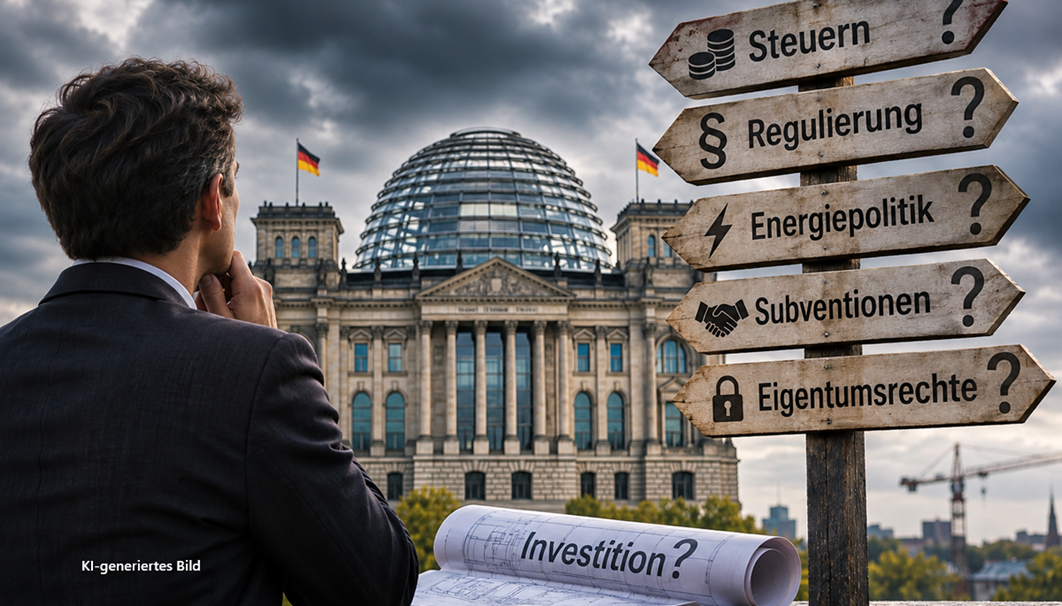
COMMENT. Germany’s lack of investment is more than just a cyclical problem. Growing uncertainty about the reliability of the market economy is threatens our long-term prosperity. The phase-out of internal combustion engines, the energy transition and government interventions in the housing market are undermining businesses’ confidence in stable operating conditions. Regime uncertainty is on the rise.
A phenomenon is taking hold in Germany: regime uncertainty. At stake is nothing less than the very foundations of the market economy itself. Neither economic stimulus programmes nor piecemeal reforms can counter regime uncertainty. The only way to tackle regime uncertainty is to return to the fundamental principles of a market economy, as formulated, for example, by Walter Eucken (Eucken, 1952).
1. What ‘regime uncertainty’ means
The American economist Robert Higgs first set out this idea in 1997 in his essay entitled ‘Regime Uncertainty: Why the Great Depression Lasted So Long and Why Prosperity Resumed after the War’ (Higgs, 1997).
Higgs argues that it is not merely the current economic policy framework that determines firms’ willingness to invest, but above all their expectations as to whether the institutional foundations of the market economy will endure in the future.
The decline in private investment in the United States during the 1930s was thus a reflection of widespread uncertainty amongst investors regarding property rights over their capital and its expected return (Higgs, 1997). The numerous state interventions under the New Deal gave entrepreneurs and investors good reason to fear that the market economy in its traditional form might not survive in the US, and that even more drastic developments – in the worst case, a kind of collectivist dictatorship modelled on fascism in Italy or communism in the Soviet Union – could not be entirely ruled out (Higgs, 1997). The then US Secretary of the Treasury, Henry Morgenthau, asked President Roosevelt during a cabinet meeting (Higgs, 2012):
“What business wants to know is: Are we headed towards socialism or are we going to continue on a capitalist basis?”
A fundamental distinction must be made between regime uncertainty and economic uncertainty on the one hand, and political uncertainty on the other. On the one hand, economic uncertainty refers to the uncertainty surrounding future economic variables such as demand, prices, costs, interest rates or profits. This uncertainty is an inseparable part of entrepreneurial activity.
On the other hand, political uncertainty refers to uncertainty regarding future taxes or regulation. Regime uncertainty goes beyond this and refers to uncertainty about the future security of private property rights and the ability to actually retain the proceeds of economic activities for oneself. It arises in particular when state intervention becomes so intense that it calls into question the long-term reliability of the market economy.
Although these three concepts can be clearly distinguished analytically, the boundaries between political uncertainty and regime uncertainty are blurred in reality. To illustrate the difference: a farmer grows apples. If this farmer does not know whether he will have to hand over a few more apples from his tree to the state at the next harvest, this constitutes political uncertainty. If he has to worry that his trees may be felled by order of the state or that the apple orchard will be nationalised, this constitutes regime uncertainty. For example, the European Green Deal is not merely conceptually linked to the New Deal. The intensity with which, for instance, the EU taxonomy can interfere with all business models has given rise to regime uncertainty (Kleinheyer, 2023).
2. Regime Uncertainty in Germany
Germany is suffering from a persistent lack of investment. In real terms, private companies are investing less today than they were a few years ago (Figure 1). At the same time, government consumption expenditure has risen sharply in recent years.

According to the KfW SME Panel 2026, although small and medium-sized enterprises in Germany are in a sound financial position, they are nevertheless conspicuously reluctant to invest. Only around 55 per cent of all companies surveyed stated that they had carried out their investments in 2026 as planned. By contrast, around 45 per cent of companies postponed, reduced or abandoned investments altogether – a higher proportion than ever before (KfW, 2026).
These figures provide an indication but are not sufficient to diagnose regime uncertainty. For this to be the case, the state must intervene in such a fundamental way that confidence in the validity of property rights is affected. Three sectors of the German economy can be identified as examples where regime uncertainty can be observed.
Automotive industry
By introducing the ban on internal combustion engines at EU level, the state has fundamentally intervened in the long-term investment decisions of an entire industry. Whilst the problematic nature of this decision has been recognised, there has so far been no resolve to completely reverse this measure. In early November, the Environment Committee of the European Parliament voted in favour of requiring CO₂ emissions from new cars in the EU to be reduced by only 95 per cent by 2035, compared with the base year of 2021. If manufacturers use climate-friendly steel (‘green steel’), they are permitted to deviate by 7.5 percentage points downwards without facing fines (Handelsblatt, 2026). Companies must expect that policymakers will continue to determine the economic future of individual technologies through regulatory intervention. The real problem is not only regulation, but also the loss of confidence in the long-term reliability of a technology-neutral competitive framework.
Energy-intensive industries
Energy-intensive industries, such as the chemical industry or the steel industry, are also affected by regime uncertainty. The politically mandated phase-out of nuclear power, the phase-out of coal and the regulatory drive towards decarbonisation are fundamentally altering production conditions. The profitability of long-term investments depends on future decisions regarding energy supply, CO₂ prices and government subsidies, the stability of which cannot be predicted. The politically driven strategy of so-called ‘green steel’ illustrates the extent of state overreach. Despite subsidies amounting to several billion euros, there are not enough buyers (Tagesschau, 2026).
Property sector
The debate in Berlin over the socialisation of large housing estates directly calls into question the long-term security of private property rights and is the clearest sign of regime uncertainty. Far-reaching interventions, such as the introduction of rent controls or the Heating Act, have already undermined confidence in the validity of the market-based property regime in the private housing market.
The rise of the political fringes and the unwillingness of the political centre to implement market-based reforms suggest that regime uncertainty in Germany is set to increase further. The influence that the European Commission can exert on companies’ business models, for example through the Green Deal, also remains a source of regime uncertainty.
3. A return to economic policy principles
With the social market economy, Germany had found a solution to regime uncertainty. The foundation consists of the constituent principles of a market-based economic order as set out by Walter Eucken in his book *Principles of Economic Policy* (Eucken, 1952). Eucken’s aim is a rule-based competitive order that limits state arbitrariness and creates reliable long-term framework conditions for entrepreneurial activity.
Of particular importance is the principle of consistency in economic policy (Eucken, 1952). According to this principle, the predictability of government action is a prerequisite for a functioning market economy. Businesses can only plan long-term investments reliably if they can trust that fundamental rules governing property, contracts and competition will remain in place.
The consistency of economic policy must be viewed in the context of the six other principles. Eucken’s principle of private property safeguards the rights of disposal over the means of production and creates incentives for long-term capital formation. Freedom of contract enables decentralised economic coordination, whilst the principle of liability ensures that business decisions and their economic consequences remain linked. The principle of open markets protects competition from politically favoured barriers to market entry and privileged interest groups. The primacy of monetary policy emphasises the central importance of a stable monetary system. Avoiding bouts of inflation is also important for combating regime uncertainty. Free prices reveal economic scarcity and enable it to be managed in a decentralised manner. If they are permanently distorted by political intervention, they lose their informational and steering function.
Unlike pension reform, these principles constitute a holistic system. Eucken’s economic policy relies on general, transparent and permanently valid rules rather than short-term, discretionary state intervention in individual markets. All these principles have fallen by the wayside politically in Germany. The more they are violated or forgotten, the more regime uncertainty increases. It is high time for a renaissance!
Short interview with Dr Marius Kleinheyer
1. What does ‘regime uncertainty’ mean, and why is it dangerous for Germany?
Marius Kleinheyer: ‘Regime uncertainty’ describes the uncertainty as to whether the fundamental rules of the market economy will continue to apply in the future. Businesses doubt whether their property rights will remain protected and whether they will be able to retain their profits. This uncertainty hinders long-term investment and thus jeopardises prosperity in Germany.
2. Why are German companies investing less and less?
Kleinheyer: Germany is currently suffering from increasing ‘regime uncertainty’. Government intervention makes it difficult to plan major investments. According to the KfW SME Panel 2026, around 45 per cent of the companies surveyed have postponed, reduced or completely abandoned investments. That is a new record high.
3. Which sectors of the economy are particularly affected by regime uncertainty?
Kleinheyer: The automotive industry, energy-intensive companies and the property sector are particularly affected. The phase-out of internal combustion engines, political mandates on energy supply and interventions in the housing market are fundamentally altering the economic framework. This makes it more difficult for companies to assess whether long-term investments are still worthwhile.
4. What should policymakers do to regain the confidence of businesses?
Kleinheyer: Germany should once again align itself more closely with the principles of the social market economy. Consistency in economic policy, as described by Walter Eucken, is particularly important. Businesses need reliable property rights, freedom of contract and open markets. Rules that remain in force over the long term build trust and facilitate long-term investment decisions.
5. On what academic findings and data is the analysis based?
Kleinheyer: The theoretical basis is provided by the work of the economist Robert Higgs on regime uncertainty, as well as Walter Eucken’s principles of economic order. Data from the Federal Statistical Office and findings from the KfW SME Panel 2026 are used to analyse investment trends. These highlight the weakness of investment in Germany.
Bibliography
Eucken, W. (1952). Grundsätze der Wirtschaftspolitik. Tübingen: Mohr SIebeck.
Handelsblatt. (2026, 04.11.). EU-Abgeordnete stimmen für Aufweichung des Verbrenner-Aus. Verkehr: EU-Abgeordnete stimmen für Aufweichung des Verbrenner-Aus
Higgs, R. (1997). Regime uncertainty: Why the Great Depression lasted so long and why prosperity resumed after the war. The Independent Review, 1(4), 561–590.
Higgs, R. (2012). Regime uncertainty: Some clarifications. The Independent Review, 17(2), 267–278.
KfW Research (2026). KfW-Mittelstandspanel 2026: Mittelstand in guter Position, den Aufschwung in Deutschland mitzutragen. KfW Bankengruppe.
Kleinheyer, M. (2023). Vom „New Deal“ zum „Green Deal“. Flossbach von Storch Research Institute.
Ohlinger, L. (2026, 19. Mai). Die Stahl-Transformation stockt. Tagesschau Online 19.5.2026.

About the author
Senior Research Analyst. Trained as a banker at the Landesbank Hessen-Thüringen in Frankfurt a.M. Studied in Freiburg, Erfurt and Madrid. Doctorate at the Universidad Rey Juan Carlos in Madrid.


Legal notice
The information contained and opinions expressed in this document reflect the views of the author at the time of publication and are subject to change without prior notice. Forward-looking statements reflect the judgement and future expectations of the author. The opinions and expectations found in this document may differ from estimations found in other documents of Flossbach von Storch SE. The above information is provided for informational purposes only and without any obligation, whether contractual or otherwise. This document does not constitute an offer to sell, purchase or subscribe to securities or other assets. The information and estimates contained herein do not constitute investment advice or any other form of recommendation. All information has been compiled with care. However, no guarantee is given as to the accuracy and completeness of information and no liability is accepted. Past performance is not a reliable indicator of future performance. All authorial rights and other rights, titles and claims (including copyrights, brands, patents, intellectual property rights and other rights) to, for and from all the information in this publication are subject, without restriction, to the applicable provisions and property rights of the registered owners. You do not acquire any rights to the contents. Copyright for contents created and published by Flossbach von Storch SE remains solely with Flossbach von Storch SE. Such content may not be reproduced or used in full or in part without the written approval of Flossbach von Storch SE.
Reprinting or making the content publicly available – in particular by including it in third-party websites – together with reproduction on data storage devices of any kind requires the prior written consent of Flossbach von Storch SE.
© 2024 Flossbach von Storch. All rights reserved.