Economy & Politics
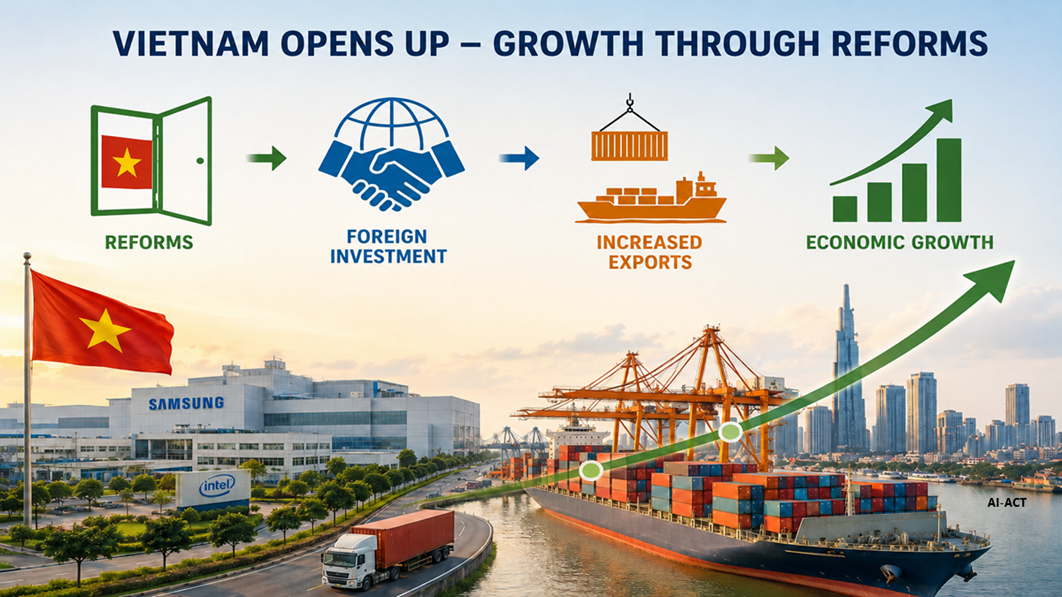
Following decades of a planned economy, war and poverty, Vietnam began to implement gradual market-oriented reforms (‘Đổi Mới’) starting in 1986. The reforms were prompted by inefficient state-owned enterprises, high public debt, inflation and famine. The government first legalised private agricultural production and later private enterprises. Prices were gradually liberalised, state-owned enterprises were reformed and a two-tier banking system was introduced. This gradualist reform process stood in contrast to Javier Milei’s ‘shock therapy’ in Argentina and thus forms an important building block for understanding reform processes.
The reforms in Vietnam brought about far-reaching macroeconomic stabilisation. Through fiscal consolidation, a more restrictive monetary policy and a controlled devaluation of the dong, inflation fell from levels of several hundred per cent at times in the late 1980s to low single-digit rates in the 1990s. At the same time, foreign direct investment increased, leading to strong growth in exports. Higher growth rates fostered private savings. Nevertheless, the ongoing gradual devaluation of the dong suggests that the process of macroeconomic stabilisation is not yet complete.
Today, Vietnam – benefiting from its membership of numerous free trade agreements – is one of Asia’s most dynamic export-oriented economies. Its export structure has shifted from agricultural products and raw materials towards industrial and electronic products. Particularly since the 2010s, Vietnam manufacturing from China (‘China Plus One’). Key export markets include the US, the EU and East Asia. At the same time, Vietnam is heavily dependent on imports from China, particularly for intermediate goods used in industrial production.
This economic rise has been accompanied by a significant increase in prosperity. Per capita income and life expectancy have risen sharply, the poverty rate has fallen significantly, and educational level have improved. However, the financial market remains underdeveloped. The capital market is small, and many companies have only limited access to credit. State-owned enterprises continue to play a major role in the economy, which means that Vietnam’s per capita income still lags significantly behind that of China, Thailand, Japan and South Korea.
This is also due to the fact that the gradual reform process has remained incomplete. Despite privatisations, the Communist Party continues to control key sectors of the economy. Economic growth is therefore driven primarily by foreign direct investment and exports. Furthermore, there are risks arising from potentially excessive credit expansion, a low birth rate and geopolitical tensions between China and the US. The recent US tariffs imposed on Vietnam over alleged ‘transhipment’ of Chinese goods underscore the risks associated with export dependency. For the economy to continue catching up, more far-reaching reforms – such as further privatisation and the liberalisation of the financial system – are necessary. Viewed in light of Vietnam's experience, Javier Milei's shock therapy appears more promising.

About the author
Gunther Schnabl heads the Flossbach von Storch Research Institute & is a professor at the University of Leipzig. He was an advisor at the European Central Bank and has conducted research at the Universities of Paris 1 Panthéon-Sorbonne, Stanford & Tokyo.


Legal notice
The information contained and opinions expressed in this document reflect the views of the author at the time of publication and are subject to change without prior notice. Forward-looking statements reflect the judgement and future expectations of the author. The opinions and expectations found in this document may differ from estimations found in other documents of Flossbach von Storch SE. The above information is provided for informational purposes only and without any obligation, whether contractual or otherwise. This document does not constitute an offer to sell, purchase or subscribe to securities or other assets. The information and estimates contained herein do not constitute investment advice or any other form of recommendation. All information has been compiled with care. However, no guarantee is given as to the accuracy and completeness of information and no liability is accepted. Past performance is not a reliable indicator of future performance. All authorial rights and other rights, titles and claims (including copyrights, brands, patents, intellectual property rights and other rights) to, for and from all the information in this publication are subject, without restriction, to the applicable provisions and property rights of the registered owners. You do not acquire any rights to the contents. Copyright for contents created and published by Flossbach von Storch SE remains solely with Flossbach von Storch SE. Such content may not be reproduced or used in full or in part without the written approval of Flossbach von Storch SE.
Reprinting or making the content publicly available – in particular by including it in third-party websites – together with reproduction on data storage devices of any kind requires the prior written consent of Flossbach von Storch SE.
© 2026 Flossbach von Storch. All rights reserved.