Companies
The euphoria on the capital markets surrounding artificial intelligence (AI) has shown clear signs of cracking. Whilst investors were still willingly betting on rising prices for AI shares this spring, the latest price falls show just how quickly sentiment can shift.
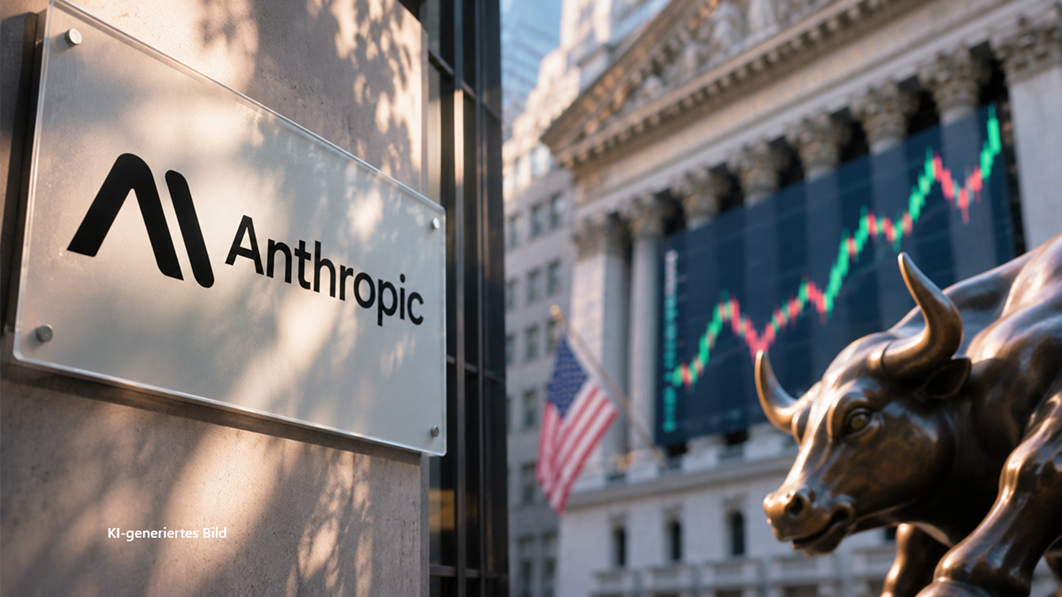
It is against this tense market backdrop that Anthropic, the company behind the Claude family of AI models, is now launching its initial public offering (IPO). Despite the recent turbulence, Anthropic could immediately rank among the ten most valuable listed companies in the US and thus quickly find its way into many investment portfolios. But how can such a valuation be justified when the economic future of the technology is virtually impossible to predict?
For investors, the question arises as to whether subscribing for Anthropic shares is worthwhile. With IPOs, many investors hope that the shares will be offered at the issue price at a lower price than they subsequently trade on the stock exchange. But why should companies sell their shares below their true value, and what role do expectations and visions play in determining the value of a share such as Anthropic’s?
Not everyone has the same interests at stake in an IPO
Firstly, it is important to realise that three stakeholder groups are involved in an IPO. On the one hand, there is the company – in this case, Anthropic. Its primary interest is to sell the shares at the highest possible price in order to raise as much capital as possible for investment. Furthermore, an IPO usually gives founders and existing investors the opportunity to cash in on their shares, so a high price is also of great interest to them.
On the other hand, there are the investors. They wish to subscribe for the shares as cheaply as possible in order to profit from a rise in price on the first day of trading. The return resulting from the difference between the issue price and the closing price on the first day of trading is known as ‘underpricing’.
The third stakeholder group consists of the investment banks. They sell the shares to their clients on behalf of the company. In doing so, they must balance the interests of the other two groups when setting the issue price of the shares. The lower the issue price, the greater the prospect of underpricing for investors. This boosts demand and strengthens the relationship between investors and the investment bank. At the same time, the company forgoes revenue – a phenomenon also known as ‘money left on the table’.
The higher the issue price, the greater the company’s revenue. At the same time, however, investor interest wanes as the share price rises, thereby reducing the prospect of underpricing. As an initial public offering (IPO) involves risks, the question arises as to how many investors would snap up if they could not expect to benefit from underpricing. Investors require an incentive to withdraw their funds from existing investments and invest in Anthropic. Without this incentive, it is doubtful whether the company will be able to place its shares successfully. A certain degree of underpricing therefore benefits both the company and the investors.
For investment banks, the challenge is therefore to attract as many investors as possible without alienating the company that has commissioned them to sell the shares.
What should the price be for a share in a company like Anthropic?
To answer this, we need to distinguish between three types of price. The issue price is set by the investment bank in consultation with the company. For SpaceX, for example, it was $135; Anthropic is targeting $70 to $78 per share.
In addition, there is the market price, which is only established through trading on the stock exchange. SpaceX, for example, began trading at $150 in June and closed its first day of trading at $161. The underpricing at the end of the first day of trading was therefore $26, or around 19 per cent. With 555.5 million shares issued, the ‘money left on the table’ therefore amounted to around US$14.4 billion.
Thirdly, there is the so-called intrinsic value of a share, also known as fair value. The intrinsic value is intended to correspond to the economic value of the company or the share. If the intrinsic value exceeds the issue price, this gives rise to the prospect of underpricing and thus an incentive for investors to buy. However, if the intrinsic value is below the issue price, the prospect of underpricing diminishes from the investor’s perspective, should the market share this assessment.
All three stakeholder groups must therefore, in one way or another, consider the intrinsic value of the share.
In the case of IPOs, the familiar valuation methods reach their limits
Determining a company’s intrinsic value is particularly difficult in the context of an initial public offering. After all, there is often less reliable information available on previously privately held companies than on those already listed on the stock exchange. In the case of Anthropic, there is the added factor that whilst the future of artificial intelligence appears promising, its future development path is largely unpredictable.
Whilst the intrinsic value of a share may seem more like a gut feeling to some investors, professional investors attempt to determine it systematically. In this regard, determining the intrinsic value in the context of an IPO works in a similar way to that for companies already listed on the stock exchange.
In principle, the value of a company can be determined as the present value of its future cash flows (Gordon 1959). This requires making assumptions about the future development of revenue and costs. To this end, equity analysts devise scenarios which they weigh up against one another to form a picture of the company’s economic future. In the case of Anthropic, the possible scenarios are likely to be so widely divergent that it is virtually impossible to derive a reliable enterprise value from them. Even looking back at past revenue growth, which exceeded 1,000 per cent, is of little help. It is impossible to predict how this growth will continue or how the cost structure will develop.
One alternative is valuation using multiples. This involves drawing on financial ratios of comparable listed companies, such as the price-to-earnings ratio. However, even this approach presents difficulties in the case of Anthropic. Anthropic, like OpenAI, which is used as a comparable company, is making losses, and other suitable comparable companies are few and far between. In contrast, for companies such as Meta or Alphabet, artificial intelligence accounts for only a part of their business.
This means that qualitative factors take on greater significance. In addition to business model, competitive advantages and management quality, expectations regarding the future development of the technology play a particularly important role for AI companies.
Such expectations are often shaped by narratives. These describe possible development paths and can help to assess a company’s future market prospects. For AI companies, however, these narratives extend far beyond the traditional business model. The focus is increasingly on the question of how artificial intelligence will transform the economy and society.
During SpaceX’s IPO, Elon Musk highlighted, amongst other things, the vision of colonising Mars (SpaceX 2026). Anthropic’s CEO, Dario Amodei, on the other hand, points to the possibility that humans may, for the first time, be able to create intelligence themselves, whilst at the same time warning of the existential risks posed by this technology (Anthropic 2026).
It is almost impossible to determine objectively how much such visions are worth today. This is precisely where the particular challenge lies in valuing Anthropic.
What others think is crucial
Valuations are always based on assumptions about the future and are therefore inherently subjective. No matter how much effort one puts in or which approaches one takes to determine Anthropic’s intrinsic value, it quickly becomes clear that the valuation of AI shares is linked to a great deal of hope and imagination.
Investors interested in stable long-term performance usually place great importance on financial metrics, track records and robust narratives. With Anthropic, however, this is only possible to a very limited extent. It is therefore not surprising that, in the IPOs of SpaceX and Anthropic, investment banks are relying more heavily than usual on distribution via banks with retail banking divisions to place the shares with retail investors, who are less concerned about valuation and economic prospects (Ranganathan 2026, Wang et al. 2026).
But what strategy should investors adopt for Anthropic’s IPO? John Maynard Keynes described such a strategy some 90 years ago. In such cases, the aim is not to make the best assessment, nor to anticipate the average expectations of market participants, but rather to anticipate what market participants think about the expectations of other market participants (Keynes 1936).
Anyone who follows this line of thought through to its logical conclusion will inevitably end up asking whether the AI sector is in a valuation bubble and whether we can expect more air to escape from that bubble. Market volatility suggests that the euphoria in the market has subsided significantly. Whether and how one can profit from Anthropic’s IPO ultimately depends on how market participants believe the market will answer these questions.
Disclaimer:
No offer to sell, purchase or subscribe for securities or other instruments is hereby made. The information contained herein does not constitute investment advice or any other recommendation.
1. Why is Anthropic’s IPO attracting so much attention?
Philipp Immenkötter: Anthropic could rank amongst the ten most valuable listed companies in the US immediately after its IPO. With Claude, the company is developing one of the leading families of AI models. Expectations regarding the economic potential of artificial intelligence are enormous. At the same time, it is uncertain whether these expectations will be met in the long term.
2. Who actually determines the share price during an IPO?
Immenkötter: The issue price is set by the investment banks involved in collaboration with the company. This involves a clash of differing interests. The company wants to raise as much capital as possible, whilst investors are hoping for a favourable entry price. A certain price discount can help generate sufficient demand and ensure the IPO is a success.
3. Why is it so difficult to determine Anthropic’s value?
Immenkötter: Traditional valuation methods reach their limits when applied to Anthropic. Although the company is growing rapidly, it continues to make losses. Furthermore, it is almost impossible to predict how revenue, costs and competition will develop. There is also a general lack of suitable comparable companies. Consequently, the valuation depends heavily on expectations regarding the economic future of artificial intelligence.
4. What role do expectations and visions play in Anthropic’s share price?
Immenkötter: Visions of the future of artificial intelligence have a significant influence on the valuation. Investors must assess the economic opportunities that arise from this. What other market participants expect is also a decisive factor. As John Maynard Keynes explained, investors often try to anticipate how other investors will assess market expectations.
5. What scientific findings and sources underpin the valuation of initial public offerings (IPOs)?
Immenkötter: An important basis is the valuation of future cash flows according to Myron Gordon. The significance of mutual market expectations was explained by John Maynard Keynes. In addition, there are company filings with the US Securities and Exchange Commission (SEC) and market analyses by Reuters, which provide insights into current IPOs.
References:
Anthropic, PBC (2026): Registration Statement on Form S-1, Amendment No. 2. U.S. Securities and Exchange Commission, 10 November 2026. Available at: https://www.sec.gov/Archives/edgar/data/2130357/000162828026072484/anthropicpbc-sx1ax2.htm (accessed on: 11 November 2026).
Gordon, Myron J. (1959): Dividends, Earnings, and Stock Prices. The Review of Economics and Statistics 41 (2), 99–105. Available at: https://doi.org/10.2307/1927792 (accessed on: 11 November 2026).
Keynes, John Maynard (1936): The General Theory of Employment, Interest and Money. London: Macmillan. Available at: https://books.google.com/books?id=v4S7AAAAIAAJ (Accessed on: 11 November 2026).
Space Exploration Technologies Corp. (2026): Registration Statement on Form S-1. U.S. Securities and Exchange Commission, 20 May 2026. Available at: https://www.sec.gov/Archives/edgar/data/1181412/000162828026036936/spaceexplorationtechnologi.htm (accessed on: 11 November 2026).
Ranganathan, Vidya (2026): From SpaceX to Anthropic, markets have a new playbook for mega-share debuts. Reuters, 12 November 2026. Available at: https://www.investing.com/news/stock-market-news/analysisfrom-spacex-to-anthropic-markets-have-a-new-playbook-for-megashare-debuts-5020374 (accessed on: 12 November 2026).
Wang, Echo / Vinn, Milana / Valle, Sabrina (2026): Musk rewrites IPO playbook with large slice of SpaceX stock for retail investors, source says. Reuters, 26 March 2026. Available at: https://www.investing.com/news/stock-market-news/exclusivemusk-rewrites-ipo-playbook-with-large-slice-of-spacex-stock-for-retail-investors-source-says-4583231 (Accessed on: 12 November 2026).

About the author
Senior Research Analyst. Graduate in Mathematical Economics, PhD in Finance from the University of Cologne, the University of Pittsburgh and the University of Trier. Expertise in capital markets, inflation, subsidies and share buybacks.
Legal notice
The information contained and opinions expressed in this document reflect the views of the author at the time of publication and are subject to change without prior notice. Forward-looking statements reflect the judgement and future expectations of the author. The opinions and expectations found in this document may differ from estimations found in other documents of Flossbach von Storch SE. The above information is provided for informational purposes only and without any obligation, whether contractual or otherwise. This document does not constitute an offer to sell, purchase or subscribe to securities or other assets. The information and estimates contained herein do not constitute investment advice or any other form of recommendation. All information has been compiled with care. However, no guarantee is given as to the accuracy and completeness of information and no liability is accepted. Past performance is not a reliable indicator of future performance. All authorial rights and other rights, titles and claims (including copyrights, brands, patents, intellectual property rights and other rights) to, for and from all the information in this publication are subject, without restriction, to the applicable provisions and property rights of the registered owners. You do not acquire any rights to the contents. Copyright for contents created and published by Flossbach von Storch SE remains solely with Flossbach von Storch SE. Such content may not be reproduced or used in full or in part without the written approval of Flossbach von Storch SE.
Reprinting or making the content publicly available – in particular by including it in third-party websites – together with reproduction on data storage devices of any kind requires the prior written consent of Flossbach von Storch SE.
© 2024 Flossbach von Storch. All rights reserved.