Economy & Politics
COMMENT. The U.S. traditionally finances wars through debt, but rising interest rates are placing tight limits on the war with Iran.
In the United States, policymakers recognized early on the crucial role played by financial markets and the Federal Reserve in financing the war. However, given the already high level of government debt, their room to maneuver in the conflict with Iran is limited, making a prolonged resource-intensive war unlikely.
1. The War with Iran Brings New Debt Burdens
War is expensive! The cost of the U.S. attack on Iran was estimated at $11.3 billion for the first six days alone. According to Harvard economist Linda Bilmes, the cost of the conflict amounts to up to $2 billion per day (Bilmes 2026). The Pentagon plans to request $200 billion from Congress for the war with Iran. Regular U.S. military spending had reached nearly $1 trillion in 2025. Costs will continue to rise if the war drags on.
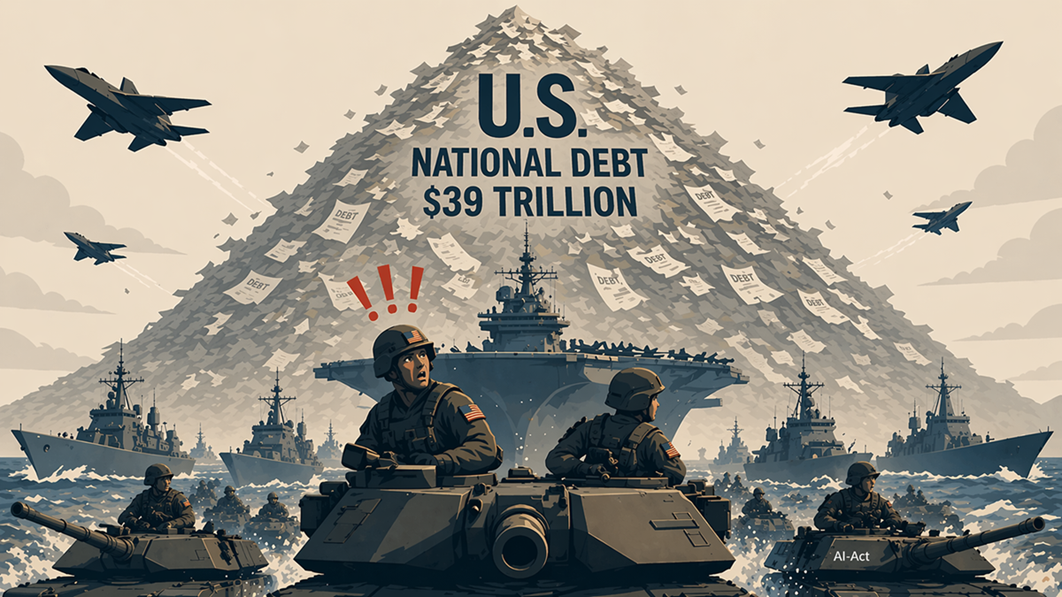
Unlike in previous wars, the debt burden was already immense before the war with Iran. The U.S. national debt stands at approximately $39 trillion. This represents a historic record of nearly 125 percent of gross domestic product (GDP). In 2025, interest payments amounted to around $1.2 trillion, exceeding military spending. A further rise in interest rates could therefore block higher military spending, even if U.S. President Donald Trump has other plans.
According to “Ferguson’s Law,” major powers reach a critical fiscal threshold when their interest payments exceed military spending. Their ability to exercise geopolitical power is then limited (Ferguson 2025). The U.S. has already crossed this threshold, while at the same time the dollar’s status as the world’s reserve currency is crumbling. Therefore, the U.S. may not be able to continue the war in Iran for long. What does the U.S. war financing reveal, from a historical perspective, about the financial viability of the war in Iran?
2. From the War of Independence to the Civil War
During the War of Independence against Great Britain (1775–1783), the North American colonies lacked a stable tax system, which is why the Continental Congress invented unbacked paper money—the “Continentals.” But because the paper money quickly lost credibility—hence the saying, “not worth a Continental”—loans from France and the Netherlands were crucial to the war effort. Although Great Britain was better able to finance itself through the Bank of England, the mother country eventually relented because the war on the other side of the Atlantic was too costly relative to the benefits.
The first U.S. Secretary of the Treasury, Alexander Hamilton, not only ensured that the federal government assumed all war debts, including those of the individual states (Assumption Plan). He also created revenue sources from customs duties and excise taxes (e.g., on whiskey) to repay the debts. This made the young nation, founded in 1776, creditworthy. An important step toward integrating financial markets into debt repayment was the founding of the First Bank of the United States (1791), which, as a primary bank for the federal government, was authorized to issue a currency backed by precious metals and grant loans to the government.

After the charter ofthe First Bank of the United States expired in 1811, the government’s financial situation deteriorated once again. This was particularly evident during the War of 1812 against Great Britain, which could only be financed through new debt at high interest rates. Inflation rose faster than the national debt (Fig. 1). In response, the Second Bank of the United States was founded in 1816. Out of concern for the concentration of financial power, President Andrew Jackson prevented the Second Bank of the United States from continuing to operate in 1836 and reduced the national debt to zero. Consequently, during the so-called Free Banking Era, a decentralized banking system emerged in which numerous banks issued their own banknotes. Since banknotes had to be redeemable for precious metals in most states, money creation was limited during the Free Banking era, causing the price level to trend downward (Fig. 1).
Until the American Civil War, total government spending amounted to around 2 percent of economic output (Fig. 2) and military spending to less than 1 percent (Fig. 3). During the Civil War (1861–1865), however, military spending rose rapidly to approximately 10 percent of economic output. The Union financed the high military spending through a combination of higher taxes, war bonds, and the issuance of paper money not backed by gold (Greenbacks). The interest rate on war bonds ranged from 5 to 6 percent, depending on the term.
The National Banking Act (1863) not only stabilized the banking system in the North because banks were henceforth regulated uniformly by the federal government—rather than differently by individual states. The Banking Act also facilitated war financing because member banks were not only permitted to issue a uniform currency (National Bank Notes) but were also required to back them with federal bonds.

The Confederacy also financed the war through property taxes, war bonds, and paper money (Greybacks). However, since the economic base was weaker than in the industrializing North and there was no uniform banking regulation, the interest rate on war bonds stood at 7 to 8 percent. Greybacks therefore played a significantly larger role in financing the war, which drove inflation sharply upward—and demoralized the population.
By the end of the Civil War, the national debt had grown from 1.5 to over 30 percent of GDP (Fig. 1). As the victor, the Union used its full economic might to service the Northern states’ debts and largely paid them off, a process aided by strong economic growth. It stabilized the Greenbacks by reintroducing a gold standard to combat inflation (Resumption of 1875). As a result, total government interest payments exceeded military spending only temporarily (Fig. 3). The Confederacy’s debts, on the other hand, were declared null and void. The Greybacks lost all their value due to high inflation.
3. World War I and World War II
After the Civil War, government spending remained almost constant at less than 3 percent of economic output for over 40 years (Fig. 2). The U.S. did not enter World War I until 1917. About one-third of the war’s high costs were financed through taxes. The top income tax rate rose to over 70 percent. Two-thirds of the funding came from Liberty Bonds. By keeping interest rates low, the Federal Reserve System—founded in 1913—created an incentive for banks to grant loans for the purchase of Liberty Bonds, which carried interest rates of 3.5 to 4.5 percent. Banks, companies, and households invested in these bonds, holding the equivalent of about 30 percent of gross domestic product by the end of the war (Fig. 1).
The price level rose significantly but remained under control. After the end of World War I, the Fed initially kept interest rates high to combat inflation. Starting in 1922–23, the Fed lowered interest rates, leading to a credit-fueled boom that reduced the ratio of government debt to GDP to just over 16 percent. However, the flood of credit triggered a speculative bubble, the bursting of which led to the Great Depression. High budget deficits resulting from the New Deal’s expansionary spending programs caused government spending as a share of GDP to rise from 3 to just under 20 percent (Fig. 2) and the debt-to-GDP ratio to swell to around 40 percent of GDP by the time the U.S. entered the war in 1941 (Fig. 1).
The United States financed World War II largely through war bonds at interest rates of about 3 percent, with significant patriotic pressure on the public to purchase them. U.S. government spending and public debt rose to historically high levels of over 36 percent (Fig. 2) and 120 percent of gross domestic product (Fig. 1), respectively. The Federal Reserve lost its independence. It was obligated to support war financing. It therefore kept interest rates low by purchasing government bonds when private demand was insufficient. Additionally, it provided commercial banks with sufficient liquidity so that they could purchase government bonds. Independence was not restored until 1951 with the Treasury-Fed Accord.

4. Financial Repression and War Financing via the Fed
After the war ended, the Fed continued to keep nominal and real interest rates on government bonds low (Fig. 4) to keep interest and debt burdens under control. The creation of the Bretton Woods system, which placed the dollar at the center of the new global monetary system, increased demand for U.S. government bonds. This helped keep interest rates low and military spending high during the Cold War. Although financial repression slows growth (McKinnon 1973), the U.S. liberalized world trade through the General Agreement on Tariffs and Trade, which generated positive growth effects. Market-oriented reforms in Germany and Japan turned both countries into engines of growth.
Thus, financial repression—evidenced in Fig. 4 by persistently low and even negative real interest rates—caused debt as a share of GDP to decline steadily (Reinhart and Sbrancia 2015 and Fig. 1). Strict regulation prevented the excesses in financial markets that had occurred between the world wars. Unlike in previous wars, government spending was no longer reduced to pre-war levels (Fig. 2) but continued to rise as a share of gross domestic product.
When the Vietnam War began driving up U.S. government spending again in the second half of the 1960s, tax increases were implemented only belatedly and in moderation because the war was unpopular. The aim was to ensure that the burden of the war would not be felt too acutely by the public. Instead, as part of the so-called “guns-and-butter” policy, social spending was increased to divert attention from the burdens of the war. This created additional debt burdens. The Federal Reserve actively purchased government bonds and kept interest rates low. Capital flowed out to the peripheral countries of the Bretton Woods system, where it put appreciation pressure on their currencies. The central banks of the partner countries in the Bretton Woods system had to buy dollars—and thus U.S. government bonds—to keep the exchange rates of their currencies stable against the dollar.
As a result, the United States’ partner countries in the Bretton Woods system helped finance U.S. war expenditures, a phenomenon the U.S. referred to as “burden sharing” and other countries as “imported inflation”. Figure 3 shows that, following the establishment of the Bretton Woods system, the U.S. was no longer forced to reduce its military spending to pre-war levels. Rather, they had the financial means to continue waging war against the Soviet Union in the form of the Cold War, the Korean War, and the Vietnam War.
The resulting rise in global inflation meant that U.S. public debt as a share of gross domestic product continued to decline, despite weak growth, to approximately 33 percent of gross domestic product (Fig. 1). French President Giscard d’Estaing lamented an exorbitant privilege enjoyed by the U.S., which allowed it to shoulder high military expenditures at the expense of other countries. McKinnon (2013) later spoke of an exorbitant privilege enjoyed by the country with the world’s reserve currency, which persisted outside Europe even after the collapse of the Bretton Woods system in the early 1970s because there was no alternative to dollar pegs there (and there still isn’t today).

After the turn of the millennium, the informal dollar standard made it easier for the U.S. to finance the costly wars in Iraq and Afghanistan, an expansionary fiscal policy in the wake of the global financial crisis (2007–2009), and extensive spending on health care and education. The dollar’s status as the world’s reserve currency—combined with the Fed’s expansionary monetary policy—has enabled persistently high budget deficits as well as the ever-increasing rise in U.S. government spending as a share of gross domestic product, because the Fed has pushed real interest rates ever lower in a new episode of financial repression (Fig. 4).
In 2025, the US government spending ratio stood at just under 38 percent of GDP (Fig. 2), and government debt as a share of gross domestic product exceeded post-World War II levels (Fig. 1). At the heart of the historically high US government debt lies the highly developed US financial market, whose backbone is US Treasuries. However, the high level of debt has also caused interest rates on U.S. government bonds to rise significantly recently due to increased inflationary pressure (Fig. 4), so that interest payments now exceed military spending (Fig. 3).
5. Outlook
Wars in the U.S. have always been accompanied by a rise in government debt, which, however, was reduced again during periods of peace for a long time. In the early years, war-induced price increases were repeatedly followed by falling price levels, so that purchasing power in the U.S. rose by around 70 percent from 1800 to 1913. A period of deflation also followed World War I due to the maintenance of the gold standard. It was not until World War II that high war and other government expenditures were accompanied by a sustained rise in the price level. However, even the 94 percent loss in the dollar’s purchasing power since 1945 has not been sufficient to keep the real debt level at a sustainable level.
The U.S. recognized early on the important role of financial markets in financing the costs of war. As early as the American Civil War, the Union gained a decisive advantage over the Confederacy in war financing by involving the banks. Since 1913, the Federal Reserve (Fed) has also been integrated into war financing. Initially, it did so by creating an incentive for banks to purchase government bonds through low interest rates.
After World War II, the creation of the Bretton Woods system brought the rest of the Western world into the financing of government spending via the Fed, which enabled continued very high military spending during the Cold War (Fig. 3). Even after the collapse of the Bretton Woods system, this exorbitant privilege persisted outside of Europe and was reinforced by the leading role of U.S. financial markets. Unlike Germany, there has been no direct default or default due to hyperinflation in U.S. history, with the exception of the Confederate States’ debt.
Since the turn of the millennium, however, the Fed has gone too far with its increasingly expansionary monetary policy. Persistently low interest rates and a rapidly growing central bank balance sheet have led to negative effects on growth and income distribution (Bessent 2025). The renewed devaluation of U.S. Treasury bonds through financial repression and dollar depreciation has reduced the willingness of many countries, such as China and Russia, to hold U.S. Treasuries. Furthermore, Bitcoin has emerged as an alternative to the dollar as an international currency (Schnabl 2024). Interest rates on U.S. Treasury bonds have risen sharply since 2022, after high inflationary pressure forced the Fed to raise rates. This has dramatically increased the U.S.’s interest burden.
According to Ferguson, the U.S. is once again at a critical juncture where the interest burden of past debts is limiting its ability to finance future military operations. Unlike in the past, however, this point has not been reached following a major war, as was the case after the Civil War or World War I. The conflict with Iran comes at a time when the U.S. has crossed a critical threshold, not only due to the wars in Iraq and Afghanistan but also because of high social spending. Since a prolonged conflict with Iran would further exacerbate the already high interest burden, a long war with Iran appears unlikely from this perspective.
________________________________________________________
References:
Bessent, Scott (2025): The Fed’s New “Gain of Function” Monetary Policy. The International Economy Spring 2025, 16–23.
Bilmes, Linda (2026): Why is the war in Iran so expensive? Harvard Kennedy School, April 7, 2026.
Ferguson, N. (2025): Ferguson’s Law: Debt Service, Military Spending, and the Fiscal Limits of Power. Hoover Institution Working Paper, February 21, 2025.
McKinnon, Ronald (1973): Money and Capital in Economic Development, Washington, D.C.: Brookings Institution.
McKinnon (2013): The Unloved Dollar Standard: From Bretton Woods to the Rise of China. Oxford: Oxford University Press.
McQuarrie, Edward F. (2021): The US Bond Market before 1926: Investor Total Return from 1793, Comparing Federal, Municipal and Corporate Bonds Part II: 1857 to 1926. Available at: https://ssrn.com/abstract=3269683
Reinhart, Carmen M., and M. Belen Sbrancia (2015): The Liquidation of Government Debt. Economic Policy 30, 82, 291–333.
Schnabl, Gunther (2024): Der Bitcoin auf dem Weg zum führenden Geld? Wirtschaftliche Freiheit 23.12.2024.

About the author
Gunther Schnabl heads the Flossbach von Storch Research Institute & is a professor at the University of Leipzig. He was an advisor at the European Central Bank and has conducted research at the Universities of Paris 1 Panthéon-Sorbonne, Stanford & Tokyo.

About the author
Research analyst and research assistant for economic policy at the University of Leipzig. Adam Smith and Carl Menger Fellow at the Mercatus Centre. Studied economics in Leipzig and Paris.


Legal notice
The information contained and opinions expressed in this document reflect the views of the author at the time of publication and are subject to change without prior notice. Forward-looking statements reflect the judgement and future expectations of the author. The opinions and expectations found in this document may differ from estimations found in other documents of Flossbach von Storch SE. The above information is provided for informational purposes only and without any obligation, whether contractual or otherwise. This document does not constitute an offer to sell, purchase or subscribe to securities or other assets. The information and estimates contained herein do not constitute investment advice or any other form of recommendation. All information has been compiled with care. However, no guarantee is given as to the accuracy and completeness of information and no liability is accepted. Past performance is not a reliable indicator of future performance. All authorial rights and other rights, titles and claims (including copyrights, brands, patents, intellectual property rights and other rights) to, for and from all the information in this publication are subject, without restriction, to the applicable provisions and property rights of the registered owners. You do not acquire any rights to the contents. Copyright for contents created and published by Flossbach von Storch SE remains solely with Flossbach von Storch SE. Such content may not be reproduced or used in full or in part without the written approval of Flossbach von Storch SE.
Reprinting or making the content publicly available – in particular by including it in third-party websites – together with reproduction on data storage devices of any kind requires the prior written consent of Flossbach von Storch SE.
© 2024 Flossbach von Storch. All rights reserved.