Economy & Politics
1. Introduction
The global challenges facing Europe are growing. Russia’s war against Ukraine is imposing heavy financial burdens on Europe. The disruptive US President Donald Trump has slapped tariffs on the world and is driving up oil and gas prices with his war against Iran. China is increasingly failing to act as a growth engine for the global economy and is threatening European industry with export subsidies. For open economies in Europe, this raises the question of which institutional and economic policy frameworks strengthen their resilience.
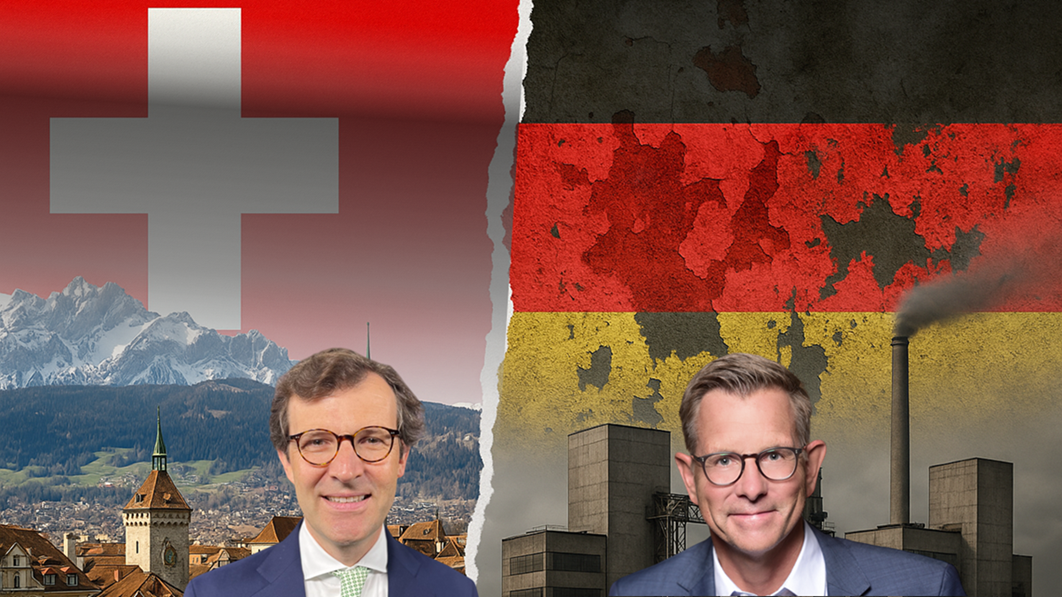
Against this backdrop, a comparison between Germany and Switzerland is revealing. Both countries are highly developed, export-oriented economies with a strong industrial base. Nevertheless, Switzerland is faring significantly better than Germany. This is evident, for example, from gross domestic product per capita. In Switzerland, it currently stands at 81,710 Swiss francs (90,240 euros), far exceeding Germany’s of 43,740 Swiss francs (48,350 euros), however. Swiss prices are almost 50 per cent higher than the German level. Adjusted for purchasing power, Switzerland’s lead still stands at around 25 per cent.
The Swiss median gross wage of CHF 7,024 is nominally around 80 per cent higher than the German figure of approximately €3,900; in real terms after deducting the higher cost of living, there is still around 20 per cent more purchasing power left. The Swiss work significantly longer hours — 42.5 hours per week compared to around 40 hours in Germany. They therefore ‘earn’ part of their higher nominal wage through longer working hours and less leisure time.
Economic growth has slowed in both countries, but since the turn of the millennium it has been higher on average in Switzerland (1.8 per cent) than in Germany (1.1 per cent). However, an interesting paradox emerges when it comes to economic growth: if population growth – primarily due to immigration into Switzerland – is factored out, both countries show similar growth in GDP per capita.
When broader indicators of prosperity and business environment are considered Switzerland performs better: life expectancy is higher, Switzerland ranks slightly ahead of Germany on the Human Development Index, the unemployment rate is lower, and the tax and social security burden on employees is lighter. Germany redistributes wealth more extensively through its social security system. The price is higher taxes and social security contributions, and consequently a greater fiscal burden on labour. Finally, wealth in Switzerland is significantly higher, but also more unevenly distributed than in Germany.
Whilst industrial production in both countries developed in parallel for a long time, their paths have diverged since at least 2019 (Fig. 1). In Germany, industrial production has declined noticeably since then. In Switzerland, it has continued to grow. This is remarkable because both economies are strongly integrated into European and global value chains, are highly export-oriented and have been exposed to similar external shocks.

Why does Switzerland appear to be more successful than Germany in maintaining industrial value added under difficult global conditions? And to what extent is this difference attributable to macroeconomic factors such as differing fiscal, monetary and economic policies?
2. Germany is relaxing its debt rules, Switzerland is not
In Switzerland, a debt brake introduced in 2003 ensures that, over the economic cycle, federal expenditure does not exceed revenue (Brandt et al. 2025). Rules to limit deficits and debt also exist at cantonal and municipal level. However, these vary across the federation. Most cantons have their own debt brakes or budget balancing rules, whilst for municipalities, cantonal financial budget laws and supervisory requirements apply.
In Germany, the EU’s Maastricht criteria have, since the early 1990s, capped the public deficit (federal, state, local and social security funds) at a maximum of three per cent and public debt at a maximum of 60 per cent of gross domestic product. In addition, since 2016, the debt brake enshrined in the Basic Law has stipulated a maximum deficit for the federal government of 0.35 per cent of gross domestic product, adjusted for economic cycles. The Länder and municipalities were required to maintain a balanced budget.
However, the EU’s debt rules were not always adhered to by many EU countries, including Germany. Since the coronavirus crisis, they have been largely suspended. In February 2025, the German debt brake was relaxed to allow for greater investment in infrastructure and defence. Parts of the newly available expenditure have since been reallocated to social spending (Henze 2025).
Since the outbreak of the global debt crisis in 2007 – fuelled by loose monetary policies – government revenue and expenditure have grown by around 50 per cent in Switzerland and by 100 per cent in Germany (Fig. 2). Since the outbreak of the coronavirus crisis, revenue in Germany has lagged significantly behind expenditure, whilst in Switzerland the budget of the entire public sector (federal government, cantons, municipalities and social security funds) has remained largely balanced. Public debt as a share of gross domestic product stood at 63 per cent in Germany in 2025 (Fig. 3), with an increase to around 100 per cent by 2035 expected following the relaxation of the debt brake. In Switzerland, the debt-to-GDP ratio was most recently 36 per cent, and unlike in Germany, a further decline is expected.

In Germany, government expenditure excluding social security funds is distributed as follows: 40 per cent to the federal government, 37 per cent to the Länder and 23 per cent to the municipalities. In Switzerland, 34 per cent of government expenditure excluding social security funds is accounted for by the federal government, 43 per cent by the cantons and 23 per cent by the municipalities, which indicates a greater degree of decentralisation in Switzerland.
Due to direct democracy, fiscal rules, referendums on tax increases and plebiscites on fund financing, there is a stronger argument in Switzerland that any additional expenditure requires clear funding. In Germany, by contrast, EU regulations in the social and environmental sectors, as well as federal laws such as the Bundesteilhabegesetz (2015), have significantly increased the financial burden on local authorities without providing adequate financial compensation.2 The resulting sharp rise in social expenditure and municipal deficits since 2017 has led to calls for a strengthening of the principle of connectivity – ‘Whoever commissions, pays’ – (Doll 2025).

3. Different constraints on monetary policy
The independence of the Swiss National Bank (SNB) is enshrined in Article 99 of the Swiss Constitution and is set out in the National Bank Act. The Federal Council may not issue instructions to the SNB regarding interest rate policy or other monetary policy decisions. Nor can Parliament force the SNB to take specific monetary policy decisions. At the same time, the SNB is accountable to Parliament, amongst others. The members of the Governing Board are elected by the Federal Council on the recommendation of the Bank Council. The Federal Council also appoints the President of the Governing Board. The SNB is therefore democratically embedded but is not bound by instructions regarding monetary policy.
The independence of the European Central Bank is enshrined in Article 130 of the Treaty on the Functioning of the European Union. Neither the ECB nor any national central bank may receive instructions from EU institutions or national governments. The President of the ECB is appointed by the European Council, acting as representation of the Heads of State or government of the member states by a qualified majority, after consulting the European Parliament. The President of the ECB (currently Christine Lagarde) must appear before Parliament regularly (quarterly hearings) and present an annual report. Parliament may question the ECB but cannot alter monetary policy.

For both countries, despite central bank independence, the scope for monetary policy decision-making is limited, albeit for different reasons. Germany has a maximum of two votes on the 27-member ECB Governing Council, even though Germany’s economic weight in the euro area is roughly 25 per cent. The southern euro countries, which hold a de facto majority on the ECB Governing Council, have traditionally shown a stronger tendency towards central bank-financed government spending and higher debt burdens (De Grauwe 2022). The heterogeneity of the euro as a currency area creates persistent pressure for a more expansionary monetary policy (Pfeifer and Schnabl 2026). Switzerland controls its own monetary policy, but as a small open economy, the exchange rate plays an important role in monetary policy decisions, meaning that the SNB’s key interest rate area is dependent on the ECB (Fig. 4, left). The traditionally lower interest rate level in Switzerland (Fig. 4, right) reflects appreciation expectations against the euro from the point of view of the open interest rate parity (Latsos and Schnabl 2018).
Both the Eurosystem’s balance sheet and the SNB’s balance sheet have grown significantly since the turn of the millennium. In Switzerland, strong capital inflows triggered by the European financial and debt crisis led to extensive foreign exchange purchases by the SNB, which significantly expanded the SNB’s balance sheet (Fig. 5). Consequently, the sharp rise in foreign investors’ assets in Switzerland is matched by significantly higher SNB investments abroad.3 In the wake of the European financial and debt crisis, the Eurosystem purchased large volumes of government bonds from the euro area countries and supranational bonds at EU level, resulting in a sharp expansion of the Eurosystem’s balance sheet as well (Adrian et al. 2024).

The Deutsche Bundesbank holds a large amount of German government bonds (approx. €900 billion). However, the most significant asset item is the claims on the ECB arising from the TARGET2 payment system, amounting to over €1,000 billion. With the exception of 2021 and 2022, the sharp expansion of central bank balance sheets has not led to a significant rise in consumer price inflation in either Switzerland or Germany, although the price level in Switzerland has remained more stable than in Germany (Fig. 6, left). However, a sharp rise in asset prices was evident in both countries, with property prices in Switzerland rising more sharply than in Germany (Fig. 6, right).
The main risk for the Swiss National Bank lies in exchange rate fluctuations, which alter the value of foreign assets when calculated in Swiss francs. The SNB incurs losses when the franc appreciates against the euro and the dollar, as the value of foreign assets then falls in terms of francs (SNB 2025). In addition there are interest rate, share price and credit risks. For example, in 2022 the SNB recorded losses of around 132 billion francs, primarily on foreign currency positions. The SNB could therefore not to distribute profits to the Confederation and the cantons. With rising government debt in the US and the euro area, the large holdings of foreign government bonds are becoming riskier.

The Deutsche Bundesbank has no currency risk on German government bonds and TARGET2 claims. Government debt as a proportion of gross domestic product is still low for Germany compared to the rest of the EU, and so is the default risk. The Deutsche Bundesbank’s TARGET2 claims are viewed by some observers as an asset that cannot be reclaimed (Sinn 2012). Should the euro area break up, there is a risk of total loss. The high deposits held by commercial banks resulting from bond purchases have led to significant losses for the Deutsche Bundesbank in recent years, as the ECB had to raise interest rates significantly since 2022. In 2024 and 2025, the Deutsche Bundesbank reported deficits of €19.8 billion and €9.8 billion respectively, meaning that no profits were transferred to the federal government.
Over time, the ECB has expanded its remit to include the supervision of large banks, climate policy and, most recently, the prospect of a digital central bank currency. The Swiss National Bank plays no active role in climate policy. It also takes a cautious approach to digital central bank money. It currently sees no need for a digital franc for the general public, whilst it is testing digital central bank money for financial institutions, known as wholesale CBDCs. Its role in financial market supervision is limited to macroprudential aspects.
4. Regulatory and industrial policy
Although Germany has had a regulatory brake in place since 2015 based on the ‘one in, one out’ principle, the EU has significantly expanded its legislative framework since the financial crisis (2008) and again as part of the Green Deal (Fig. 7). Germany is said to implement EU regulations particularly strictly (gold plating). The EU taxonomy stipulates that all companies must be classified according to environmental and climate criteria and that lending will in future be aligned with these classifications (Kooths 2022). This entails immense reporting obligations for companies and banks.
In Switzerland, financial market regulations have been significantly expanded, particularly since 2015 (PWC 2026). The EU taxonomy does not yet apply directly to Switzerland. However, it has an indirect impact via financial markets, supply chains and European customers. At the same time, the negotiated but not yet ratified Switzerland-EU package (Bilateral III) provides for the dynamic adoption of EU law in certain areas of the single market. The regulatory gap with the EU is therefore likely to narrow further — with consequences for Switzerland’s regulatory autonomy and its profile as a business location (EDA 2026).

For Germany, although state aid to companies is incompatible with the EU internal market under Article 107 TFEU, the European Commission may approve aid for specific projects. The de minimis Regulation (2001), the General Block Exemption Regulation (GBER) (2008) and the Guidelines on State Aid for Climate, Environmental Protection and Energy (CEPAE 2022) have created far-reaching exemptions, with the result that subsidies in Germany have risen sharply since 2018 (Immenkötter 2026). The German Federal Government’s subsidy report shows a total volume of €117.1 billion for the year 2025 (Bundesministerium der Finanzen 2025). The Kiel Subsidy Report quantifies financial aid and tax breaks at a total of €285 billion for 2024, which corresponds to approximately 6.6 per cent of gross domestic product (GDP) (Laaser, Rosenschon and Schrader 2024). According to the Freiburg Subsidy Report, the projected value of subsidies will reach €321 billion in 2026 (Feld et al. 2026).

In Switzerland, subsidies are generally permitted but are subject to budgetary law and the debt brake. The Federal Constitution (Art. 103 BV) permits the Confederation to pursue structural policy if the existence of individual economic sectors or regions is threatened, for example in agriculture. The Institute for Swiss Economic Policy estimates subsidies at around 50 billion Swiss francs, which corresponds to 5.6 per cent of gross domestic product (Mosler, Schaltegger and Schmitter 2024). Among other things, the study identifies subsidies for farmers, circuses, parliamentarians, hotels, the film industry, pensions, public transport and gamblers. Direct subsidies for industry are rare, unlike in Germany.
In Germany, social expenditure has risen steadily to around 1,400 billion euros in 2025, corresponding to a social benefit ratio of over 30 per cent. A large proportion of this is accounted for by the statutory pension scheme, including subsidies for the statutory pension scheme amounting to around 130 billion euros from the federal budget. Statutory health insurance is also reliant on subsidies from the federal budget. Most recently, the 5.5 million recipients of the basic income received around 50 billion euros, although around 4 million of them are considered able to work. In Switzerland, social expenditure has risen to around 105 billion Swiss francs in 2024. According to the IMF’s narrow definition, social expenditure as a share of gross domestic product stands at 20 per cent in Germany, significantly higher than in Switzerland at 12.5 per cent (Fig. 8).
Part of this difference can be explained by the institutional structure of the Swiss welfare state. Alongside state old-age and survivors’ insurance (Alters- und Hinterlassenenversicherung), occupational pension schemes, premium reductions under compulsory health insurance, and benefits organised at cantonal and municipal level play a significant role. Social assistance is designed on a subsidiary basis and carries less fiscal weight compared to other social insurance schemes. The more decentralised structure of social security can improve the precision with which funds are allocated. Because cantons and municipalities are closer to the specific social issues at hand, support services can be tailored more closely to local needs. However, this does not alter the fact that demographic pressure is also increasing in Switzerland. Social welfare is now by far the largest expenditure item in the federal budget (Schaltegger and Mair 2026).

In the wake of sharply rising government revenues, employment in the public sector (public administration, education and health) has risen significantly in both Germany and Switzerland. In Germany, the increase of 2.9 million in the public sector since 2007 has been accompanied by a further rise in employment of 1.2 million in other services. The latter can be linked to increasing regulation and the expansion of funding for non-governmental organisations (NGOs). This process has been accompanied by growing dysfunction in public services, particularly in the education sector, railways and public construction projects, which have been marked by immense construction delays and soaring costs (Duarte et al. 2025).
In Switzerland, the number of people employed in the public sector has risen even more sharply than in Germany – by around 470,000 since 2007 – and has approached the level seen in Germany as a proportion of the total workforce (Fig. 9). This is attributable in particular to the expansion of employment in the education sector and in healthcare. There is no discussion in Switzerland of a deterioration in the quality of public goods. The Swiss railways continue to impress with their punctuality, and public construction projects do not run over budget. One possible explanation lies in the institutional framework, which keeps planning and approval procedures comparatively predictable. This could also include the more restrained formulation of environmental regulations.
5. Outlook
In 2025, government expenditure as a proportion of gross domestic product stood at around 30 per cent in Switzerland, compared with around 50 per cent in Germany, which is a robust indicator of greater economic freedom in Switzerland. Although government expenditure has also risen sharply in Switzerland since 2007, the increase has been smaller. Regulation also appears to be less pronounced in Switzerland than in Germany, with regulations in Germany having grown significantly as a result of EU legislation – often unnoticed by the German public during the drafting phase. Switzerland’s direct democracy, in which citizens can challenge laws through referendums, appears to provide a stronger control mechanism against decisions driven by political interests and lobbying.

There is one key difference in monetary policy. The introduction of the euro effectively marked a departure from the Deutsche Bundesbank’s stability-oriented monetary policy (Pfeifer and Schnabl 2026), with the result that the euro has continued to depreciate against the Swiss franc since the European financial and debt crisis (Fig. 10). Before the introduction of the euro, the strong German mark and the strong Swiss franc acted as ‘productivity whips’ due to their steady appreciation against the dollar and other European currencies. Appreciation pressure has have constantly forced German and Swiss companies to repeatedly increase their efficiency and bring high-quality, less price-sensitive products to market. This productivity whip no longer applies to Germany’s exporting companies (Schnabl 2024), but it remains in place for the Swiss economy. The Swiss National Bank’s monetary policy thus makes a significant contribution to the Swiss economy’s continued high level of international competitiveness.

This is reflected in the trend in unit labour costs. Whilst these have remained largely constant for Switzerland since 2008 and have risen only slightly since 2020, a marked increase can be seen for Germany from 2008 onwards, which has accelerated significantly further since 2020. The relative trend in unit labour costs (Fig. 11) may explain why Swiss industry has performed significantly better than German industry despite the appreciation of the Swiss franc (Fig. 1). The significant rise in government spending, accompanied by a sharp increase in public sector employment since 2008, does not appear to have harmed the resilience of industrial production in Switzerland.
The rise in public sector employment in Germany since 2008, by contrast, has been accompanied by a decline in industrial production. The sharp rise in public sector employment since 2008 has thus been accompanied by growth in industrial production in Switzerland, whereas this is not the case in Germany. The future competitiveness of the German economy will depend heavily on reforms, which are politically difficult to implement due to the complex decision-making mechanisms within the EU.
__________________________________________________
1 We would like to thank Lukas Mair and Tom Bugdalle for their excellent support.
2 The funding shortfall for local authorities’ obligations under the Federal Participation Act stands at around 30 billion euros (DeStatis 2025).
3 The SNB bears a large part of the revaluation risks associated with Switzerland’s foreign investments but also has control over the revaluation of the currency itself.
____________________________________________________
Literature
Adrian, Tobias, Erceg, Christopher, Kolasa, Marcin, Lindé, Jesper, Zabczyk, Pawel (2024):
Macroeconomic and Fiscal Consequences of Quantitative Easing.
IMF Working Paper 2025/158.
Brandt, Przemyslaw / Mair, Lukas / Mosler, Martin / Schaltegger, Christoph A. 2025: Die Schweizer Schuldenbremse: empirische Effekte auf Schuldenquote und Ausgabekategorien. Perspektiven der Wirtschaftspolitik, 26, 2, 113-163.
Bundesministerium der Finanzen 2025: 30. Subventionsbericht des Bundes 2023-2026, Berlin, 10.9.2025.
De Grauwe, Paul 2022: Economics of Monetary Union von Paul De Grauwe. 14. Auflage, Oxford University Press, Oxford.
DeStatis 2025: Ausgaben und Einnahmen der Eingliederungshilfe nach dem SGB IX. Berlin.
Doll, Nikolaus 2025: Die kaum bekannten Kostentreiber des ausufernden Sozialstaats, Die Welt Online, 26.10.25.
Duarte, Pablo / Gehringer, Agnieszka / Mayer, Thomas / Schnabl, Gunther 2025: Der Standort Deutschland fällt zurück - eine Ursachenanalyse und wirtschaftspolitische Empfehlungen. Flossbach von Storch Research Institute 11.9.2025.
Eidgenössisches Departement für auswärtige Angelegenheiten EDA 2026: Inhalt des Pakets Schweiz–EU (Bilaterale III). Bern.
Feld, Lars / Freytag, Adreas / Laaser, Claus-Friedrich / Langer, Maximilian / Rosenschon, Astrid / Thomas, Maximilian 2026: Freiburger Subventionsbericht 2026. München.
Henze, Tobias 2025: Sondervermögen, Infrastruktur und Klimaneutralität: ein Verschiebebahnhof mit vielen Gleisen. IW-Kurzbericht 92/2025.
Immenkötter, Philipp 2026: Milliarden mit Nebenwirkungen: Deutschlands neue Subventionspolitik. Flossbach von Storch Research Institute 19.5.2026.
Immenkötter, Philipp / Schaltegger, Christoph / Schnabl, Gunther 2025: Reiche Schweiz – armes Deutschland? Youtube-Interview, Flossbach von Storch Research Institute, 10.7.2025.
Laaser, Claus-Friedrich / Rosenschon, Astrid / Schrader, Klaus 2024: Kieler Subventionsbericht 2024: Hohe Subventionen trotz Haushaltsengpässen. Kieler Beiträge zur Wirtschaftspolitik 48.
Kooths, Stefan 2022: EU Taxonomy, Mission Impossible. The Economists’ Voice 19, 2, 243-249.
Mosler, Martin / Schaltegger, Christoph / Schmitter, Simon 2024: Klarheit schaffen: Der IWP-Subventionsreport 2024. Institut für Schweizer Wirtschaftspolitik Studien.
Pfeiffer, Moritz / Schnabl, Gunther 2026: Der Euro als optimaler Währungsraum? Eine Bestandsaufnahme. Flossbach von Storch Research Institute, 9.1.2026.
PWC 2026: Regulatorische Entwicklungen in den Branchensektoren Banken, Asset Management und Versicherungen. Aufsichtsrechtliche Projekt 03/26.
Schaltegger, Christoph A. / Mair, Lukas 2026: Swiss Fiscal Policy after the End of the Fiscal Comfort Zone. The Economists’ Voice.
Schnabl, Gunther 2015: Japans Lehren für das Schweizer Wechselkursdilemma. Wirtschaftsdienst 95, 3, 192-1999.
Schnabl, Gunther 2024: Deutschlands fette Jahre sind vor. Wie es kam und wie wir ein neues Wirtschaftswunder schaffen können. FinanzBuch Verlag, München.
Schweizer Nationalbank SNB 2025: Zwischenbericht der Schweizerischen Nationalbank per 30. Juni 2025, 31.7.2025
Sinn, Hans-Werner 2012: Die Target-Falle – Gefahren für unser Geld und unsere Kinder, Carl Hanser Verlag, München.

About the author
Gunther Schnabl heads the Flossbach von Storch Research Institute & is a professor at the University of Leipzig. He was an advisor at the European Central Bank and has conducted research at the Universities of Paris 1 Panthéon-Sorbonne, Stanford & Tokyo.


Legal notice
The information contained and opinions expressed in this document reflect the views of the author at the time of publication and are subject to change without prior notice. Forward-looking statements reflect the judgement and future expectations of the author. The opinions and expectations found in this document may differ from estimations found in other documents of Flossbach von Storch SE. The above information is provided for informational purposes only and without any obligation, whether contractual or otherwise. This document does not constitute an offer to sell, purchase or subscribe to securities or other assets. The information and estimates contained herein do not constitute investment advice or any other form of recommendation. All information has been compiled with care. However, no guarantee is given as to the accuracy and completeness of information and no liability is accepted. Past performance is not a reliable indicator of future performance. All authorial rights and other rights, titles and claims (including copyrights, brands, patents, intellectual property rights and other rights) to, for and from all the information in this publication are subject, without restriction, to the applicable provisions and property rights of the registered owners. You do not acquire any rights to the contents. Copyright for contents created and published by Flossbach von Storch SE remains solely with Flossbach von Storch SE. Such content may not be reproduced or used in full or in part without the written approval of Flossbach von Storch SE.
Reprinting or making the content publicly available – in particular by including it in third-party websites – together with reproduction on data storage devices of any kind requires the prior written consent of Flossbach von Storch SE.
© 2024 Flossbach von Storch. All rights reserved.