Economy & Politics
STUDY. Kevin Warsh officially took office as Chairman of the Federal Reserve on 15 May 2026. Whilst the Fed’s balance sheet grew at a historically strong rate under his predecessor Jerome Powell, Warsh is calling for a significant reduction in the Fed’s balance sheet. What would this mean for US monetary policy?
1. A shift in US monetary policy?
For many years, the US central bank, the Fed, much like the European Central Bank (ECB), conducted monetary policy by adjusting key interest rates with banks facing a shortage of liquidity. This conventional monetary policy was replaced by an unconventional monetary policy in the wake of the global financial crisis. After key interest rates had been cut to near zero, asset purchases – and thus changes in the size of the Fed’s balance sheet – became the primary monetary policy instrument. Unconventional monetary policy affected the economy and financial markets via changes in interest rates at the long end of the yield curve. The Fed’s balance sheet expanded significantly as a result of these securities purchases. Despite so-called quantitative tightening since 2022, the Fed’s balance sheet still stands at $6.7 trillion (compared to €6.2 trillion for the Eurosystem) (Fig. 1), which is significantly higher than the level prior to the turn of the millennium.
The incumbent US Treasury Secretary, Scott Bessent (2025), has argued that by significantly expanding its balance sheet, the Fed has extended its remit beyond the statutory dual mandate of price stability and full employment. The Fed’s theoretical models were flawed, he argued, meaning that the Fed failed to recognise inflationary risks and overestimated the growth effects of its policies. The Fed had redistributed wealth from the poor to the rich. Through its excessive purchases of government bonds, the Fed had blurred the line between monetary and fiscal policy. In doing so, it had not only encouraged unsound government fiscal policy but had also gradually relinquished its independence.

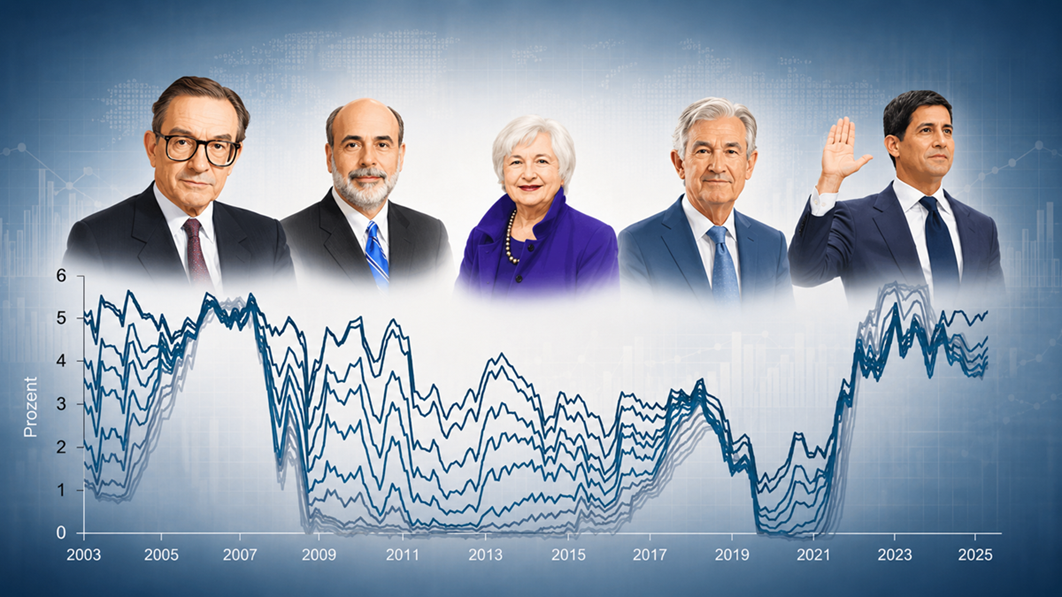
Of the five candidates1, Kevin Warsh – arguably Bessent’s preferred choice – has won the race to become the new Fed Chair (Schnabl 2026). Kevin Warsh was a member of the Fed’s Board of Governors under Ben Bernanke from 2006 to 2011 and has sharply criticised the Fed’s programmes to stimulate growth and employment (Warsh 2025). He resigned well before the end of his term. In the race for the Fed chairmanship, he argued, on the one hand, that the Fed could cut interest rates in response to AI-driven productivity gains, thereby meeting US President Donald Trump’s calls for rate cuts. On the other hand, during his confirmation hearing before the Senate Banking Committee, Warsh advocated a targeted reduction of the Fed’s balance sheet. What direction can we expect US monetary policy to take under the new Chair Warsh? Will the world’s most important central bank lose or gain independence?
2. Key points of Warsh and Bessent’s criticism
The balance sheet of the US Federal Reserve has grown significantly since the outbreak of the US subprime crisis, following four rounds of so-called quantitative easing (Fig. 1). According to Bessent (2025), the continuation of financial market stabilisation measures beyond the global financial crisis has systematically distorted the capital markets. Massive bond purchases have artificially suppressed risk premiums and systematically forced investors into high-risk assets. This has created an expectation in the financial markets that the Fed will step in to rescue the situation whenever there is market turbulence.2 It can be inferred from this that the prices of high-risk assets such as stocks and real estate are overvalued.
Bessent (2025) has argued that, through the excessive purchase of government bonds, the Fed has blurred the line between monetary and fiscal policy and encouraged poor fiscal policy. Kevin Warsh has described the current situation, in which the Fed acts as a major creditor to the US government, as ‘fiscalpolicyin disguise’ (Rev 2026). This practice encourages rising debt ratios and increases the risk of ‘fiscal dominance’, i.e. persistent pressure from the government on the central bank to contribute to the financing of government expenditure through the purchase of government bonds. Government debt in the US has grown correspondingly sharply (Fig. 2).


The central bank’s inflation of asset prices has negative effects on growth, as companies’ share prices rise even without efficiency gains. Banerjee, Doerr and Hofmann (2024) argue that persistently low interest rates in many countries have dampened companies’ pursuit of efficiency gains.3 Bessent (2025) notes that the expansion of the Fed’s balance sheet primarily benefited Wall Street at the expense of Main Street. According to Warsh (2018), the Fed has widened wealth inequality by driving asset prices sharply upwards through the expansion of its balance sheet (see Fig. 3). The share of total net wealth held by the richest one per cent of the population in the US has risen from 27.9 per cent in 2000 to 31.7 per cent most recently. From this perspective, reducing the size of the Fed’s balance sheet becomes a key factor if the aim is to ‘make America great again’ – as promised in the MAGA programme.
3. The new Treasury-Fed Accord and its risks
Kevin Warsh has proposed a ‘new Treasury-Fed Accord’, alluding to the historic Treasury-Fed Accord of 1951 (Xie, MacKenzie and Capurro 2026). During the Second World War, the Federal Reserve was obliged to support the costly war. It kept interest rates down by purchasing government bonds when private demand was insufficient. It also provided commercial banks with sufficient liquidity to enable them to buy government bonds. It was not until 1951 that the Fed was released from its obligation to support US government financing through the purchase of government bonds and artificially low interest rates. In this sense, Warsh advocates a return to a more rule-based separation of monetary and fiscal policy.
Furthermore, Warsh proposes coordination between the Treasury and the Fed. The Treasury could issue more short-term Treasury bills, whilst the Fed should rebalance the structure of its reduced holdings of US government bonds in favour of short-term government bonds.4 Long-term interest rates would thus once again be determined more by the market, whilst the Fed would once again determine the short end of the yield curve.5 This would correspond to a steeper yield curve (ABN Amro 2026). Warsh also calls for the Fed to ‘withdraw’ from the US housing market by reducing its immense holdings of mortgage-backed securities (see Fig. 4) (Financial Content 2026).
Following the US subprime crisis, key interest rate cuts have brought short-term rates down to zero, whilst the Fed’s balance sheet expansion has pushed down long-term rates. Compared to 2002, this has lowered and flattened the yield curve (see 2002 versus 2021 in Fig. 5).6 Significant policy rate hikes in response to the sharp rise in inflation from 2022 onwards have since pushed up the short end of the yield curve again. The long end, however, remains lower than in 2002, even though government debt and inflation are significantly higher than in 2002. A steeper yield curve would imply lower key interest rates and higher long-term rates, which is in line with Warsh’s idea of “QT-for-Cuts”. Short-term interest rates could fall if, at the same time, the Fed’s massive balance sheet is reduced, for instance through the active sale of mortgage-backed securities (MBS) (Financial Content 2026).


Neither Scott Bessent nor Kevin Warsh has so far made any concrete proposals as to how and over what timeframe the Fed’s balance sheet should be reduced. This prevents risks from being priced in by the financial markets in a timely and erratic manner.7 The US government is heavily indebted and faces high interest costs. A reduction in the Fed’s balance sheet would cause commercial banks’ deposits with the Fed to fall, thereby increasing their liquidity risks.8 The sale of the substantial holdings of mortgage-backed securities (Fig. 4) gives rise to risks due to rising interest rates on politically sensitive property loans. A rise in long-term interest rates would increase borrowing costs for corporate investment, which could lead to a long-term economic crisis in the US economy.
4. Countermeasures against the risks of balance sheet reduction
The biggest problem with balance sheet reduction is likely to be the high level of US government debt, which has risen to $39 trillion in the wake of sustained expansionary monetary policy. It is accompanied by immense interest burdens on the US federal budget amounting to around $1.2 trillion (Fig. 2). Whilst the Fed held around 25 per cent of outstanding government bonds prior to the quantitative tightening that began in 2022, this figure currently stands at around 14 per cent (Fig. 6). The interest rate on 10-year US government bonds has risen from 1.6 per cent in December 2021 to around 4.6 per cent currently as a result of monetary policy tightening9, which has created significant additional interest costs for the US government. It is therefore reasonable to assume that a further reduction in the Fed’s balance sheet would cause the interest burden on the US government to rise further, thereby further eroding the international credibility of the dollar as a reserve currency.
The proportion of short-term bonds in outstanding government debt (maturity of up to one year) currently stands at just over 30 per cent (Fig. 7). As a countermeasure against further rising interest costs, the US government can substitute higher-yielding long-term bonds with lower-yielding short-term bonds, particularly when short-term interest rates fall.10 Since December 2025, the Fed has been selectively purchasing short-term Treasury bills whilst allowing long-term bonds to mature. In doing so, it is shortening the average maturity of its holdings. Stronger private demand for short-term US government bonds arises when US banks hold more short-term Treasury bills as a liquidity reserve (see below). The GENIUS Act stipulates that stablecoins issued by US financial institutions must be backed by safe and highly liquid assets – i.e. in particular short-term Treasuries. As international demand for stablecoins is likely to be high11 , foreign countries would continue to contribute to the low-interest financing of US government debt. According to Scott Bessent, the Fed’s reduction of mortgage-backed securities is to be offset by corresponding purchases by the Treasury (Lawder 2026).

Nevertheless, should the Fed’s balance sheet be reduced, the US debt burden is unlikely to be sustainable without further success in cutting government spending. The US budget deficit currently stands at around 6 per cent of gross domestic product. Social spending, interest payments and defence expenditure are difficult to cut (Bogage 2025). The war with Iran has created additional risks. The cost savings from reducing public sector employment are considerable, but are being held back by the courts.12 On the positive side, however, growth remains high compared to other industrialised countries, bolstered by tax cuts and reductions in social spending under the Big Beautiful Bill. As a result, nominal growth exceeds interest rates on government bonds (r<g), which helps to keep the growth of public debt as a share of gross domestic product under control.

The sale of government bonds and mortgage-backed securities by the Fed would reduce commercial banks’ high deposits with the Fed (Fig. 8), which could cause turbulence in the interbank market.13 According to Anderson et al. (2026)14, the requirements for banks’ liquidity holdings could be relaxed and Treasury bills accepted as an equivalent substitute for central bank reserves.15 Banks should be able to refinance more easily via the Fed’s discount window. Commercial banks’ reserves held with the Fed should be subject to different interest rates – for example, by distinguishing between minimum and excess reserves – to make excessive reserve holding less attractive. According to Anderson et al. (2026), the Fed could reduce its balance sheet by around 1.2 to 2.1 trillion dollars through regulatory changes. Furthermore, the Fed is currently planning to relax banks’ capital rules, which create additional scope for lending (Handelsblatt 2026).
Finally, there remains the risk of rising long-term interest rates for the corporate sector. On the one hand, the number of insolvencies could rise. On the other hand, rising financing costs for companies can be seen as an incentive to increase efficiency. Kevin Warsh’s strong advocacy of productivity-oriented growth is said to have already favoured highly efficient technology companies over speculative ‘moonshot’ start-ups (Financial Content 2026). Artificial intelligence offers significant potential for efficiency gains across broad sections of the economy, which is likely to be better utilised if interest rates rise. AI-driven productivity gains could lead to the actual value of companies converging once again with their current, potentially overvalued share prices.

5. Outlook
The appointment of Kevin Warsh as the new Chair of the US Federal Reserve marks a turning point in terms of communication. The view that the central bank can and should stabilise the economy and financial markets by expanding its balance sheet in all kinds of crises – a view that still prevailed under Jerome Powell – has been rejected. The plan to reduce the Fed’s balance sheet appears well-founded and forward-looking in terms of its objectives and the anticipation of potential risks. This points to greater central bank independence.
The stable, competence-based appointment process for Kevin Warsh signals that the Trump administration knows what it wants and is acting on it. Given that the yield curve has remained very flat following the interest rate hikes since 2022, the aim is to achieve a steep per yield curve, as Warsh advocated prior to the start of four rounds of Quantitative Easing (QE) (2008–2022) (Fig. 9). By shrinking its balance sheet, the Fed would lower long-term inflation expectations and regain greater room for manoeuvre in the face of inflation. With the concept of ‘trimmed mean inflation’ as the inflation measure16 targeted by Warsh, the most extreme price movements would be removed from the basket of goods (both upwards and downwards), thereby also orienting monetary policy towards the longer term.
Whether Kevin Warsh will be able to prevail, however, remains uncertain. With the appointment of Kevin Warsh to the Fed’s Board of Governors, only three of the seven members are currently appointed by Republican presidents (Kevin Warsh, Michelle Bowman and Christopher Waller), whilst four were appointed by Democratic presidents (Jerome Powell, Philip Jefferson, Lisa Cook and Michael Barr). Jerome Powell’s unusual decision to remain on the Board of Governors after the end of his presidency suggests that there is a dispute over direction within the Board of Governors (see also Schnabl 2026). The Republicans would only achieve a majority in this key decision–making body of the Fed once Jerome Powell’s official term of office ends on 31 January 2028.17 Furthermore, it is unclear how the majority of regional central bank presidents will position themselves within the Federal Open Market Committee (FOMC).

Whilst key decision-makers at the US Federal Reserve and Treasury recognise the limits to the sustained expansion of the Fed’s balance sheet, similar discussions are not on the horizon in other currency areas such as Japan, the UK and the euro area. Rather, it can be assumed that structurally expansionary monetary policies in Japan and the euro area will continue, whilst the US aims to stabilise the dollar. This is likely not only to strengthen the dollar’s leading international role, but also to bolster the banking sector, the capital market, the economy and growth in the US through capital inflows.
Short Interview with Prof. Dr Gunther Schnabl
Why is Kevin Warsh’s appointment as Fed chairman so significant?
Gunther Schnabl: With Kevin Warsh, for the first time in many years, the Fed is led by a chairman who fundamentally questions the massive expansion of the central bank’s balance sheet over the past two decades. While the Fed has kept interest rates low and increasingly relied on bond purchases since the global financial crisis, Warsh wants to significantly reduce the balance sheet.
Why is a battle of narratives, fueled by Donald Trump, looming?
Schnabl: Kevin Warsh was appointed by U.S. President Donald Trump, who has repeatedly attacked the current Fed Chair Jerome Powell as incompetent and openly called for interest rate cuts. That is why Jerome Powell is widely seen as a defender of central bank independence and, by extension, monetary stability. Yet under no other U.S. central bank chair has the Fed’s balance sheet grown as much as under Jerome Powell. Now Kevin Warsh is positioning himself as a monetary policy hawk. The markets currently do not expect interest rate cuts. Donald Trump has even recently emphasized Warsh’s independence.
What do Kevin Warsh and U.S. Treasury Secretary Scott Bessent criticize about the Fed’s policy to date?
Schnabl: They argue that the Fed’s massive bond purchases have blurred the line between monetary and fiscal policy. The Fed has driven asset prices sharply higher and eased the burden of government debt. The Fed has favored Wall Street at the expense of Main Street. As a result, wealth inequality has risen sharply.
What is the central idea behind Kevin Warsh’s reform concept?
Schnabl: Warsh is aiming for a stronger separation of monetary and fiscal policy. The Fed should reduce its holdings of long-term government bonds and mortgage-backed securities. Long-term interest rates should be determined more by the market, while the Fed primarily controls the short end of the yield curve. The yield curve would become steeper again. The Fed should focus on its core mandate: combating inflation and unemployment. Its decisions should be oriented toward the long term.
What opportunities does the monetary policy envisioned by Kevin Warsh offer?
Schnabl: A smaller Fed balance sheet could strengthen the central bank’s independence and reduce market distortions. Higher long-term interest rates could redirect capital more toward productive investments, thereby stimulating economic growth. The erosion of the dollar’s role as the international reserve currency would be halted.
What risks does a shift in monetary policy in the U.S. entail?
Schnabl: The U.S. is significantly more indebted today than it was before the financial crisis. A balance sheet reduction would raise long-term interest rates, thereby increasing the already immense interest costs for the government further. By selling bonds, the Fed would reduce commercial banks’ deposits with the Fed, which serve as an important liquidity reserve for the banks. This could trigger instability in the interbank market. Rising mortgage rates pose a social risk. Rising lending rates could slow investment and growth.
What is Warsh planning to counter the risks of the Fed’s balance sheet reduction?
Schnabl: The Fed intends to hold more short-term government bonds—which carry lower interest rates—rather than long-term ones, which would reduce the government’s interest burden. Demand for short-term Treasuries is also likely to grow due to the new regulation on stablecoins. Banks’ liquidity risks can be reduced by easing liquidity requirements. According to statements by the U.S. Treasury Secretary, the government will purchase the mortgage-backed securities that the Fed sells. From Warsh’s perspective, higher lending rates should lead companies to more consistently leverage the potential for productivity gains that AI brings.
Will Warsh be able to push through his plans at all?
Schnabl: The fact that the current Fed Chair, Jerome Powell, has remained on the Fed’s Board of Governors contrary to custom suggests a political power struggle over the Fed’s future direction. Within the Board of Governors, members appointed by Democratic presidents currently still hold the majority. Furthermore, it is unclear how the regional Fed presidents will position themselves on the Open Market Committee.
How do you assess the Fed’s new monetary policy under Kevin Warsh overall?
Schnabl: Kevin Warsh’s appointment marks a significant shift in the monetary policy debate. He challenges the paradigm that central banks should stabilize the economy and financial markets by expanding their balance sheets. Whether this will lead to a lasting turnaround depends on the political majorities within the Fed. It also depends on how the Fed and the Treasury proactively will contain potential risks. The groundwork for this is currently being laid. If the turnaround succeeds, it could ultimately lead to the stabilization of the global economy through productivity-driven growth.
_____________________________________________
1 In October 2025, US Treasury Secretary Scott Bessent, who was leading the selection process, announced a shortlist of five names: Fed governors Christopher Waller and Michelle Bowman, former Fed governor Kevin Warsh, National Economic Council Director Kevin Hassett, and BlackRock investment banker Rick Rieder. On the betting platform Polymarket, Christopher Waller was initially in the lead, followed by Kevin Hassett and finally Rick Rieder. In the end, Kevin Warsh won the race.
2 For the effects of increasingly expansionary monetary policy on financial markets, the economy and society, see also Schnabl (2019).
3 Often dubbed as ‘zombification’ of the economy.
4 Critics see this as a new risk to the Fed’s independence, as closer coordination between the Treasury and the central bank can be interpreted as monetary financing of the government.
5 However, the Fed would also have an influence on long-term interest rates via inflation expectations.
6 The yellow line in Fig. 5 shows the yield curve in Japan under the very extreme yield curve control (YCC) pursued by the Bank of Japan from September 2016 to March 2024.
7 Nevertheless, rising long-term interest rates and falling gold and Bitcoin prices, for example, were attributed to a more stability-oriented reorientation of US monetary policy (Financial Content 2026).
8 The Fed’s balance sheet reduction between 2017 and 2019 drained reserves from the banking system, with the Fed underestimating commercial banks’ structural demand for reserves under Basel III regulations. Consequently, on 17 September 2019, the overnight repo rate temporarily jumped to between 8 and 10 per cent, even though the Fed Funds Rate target range was only around 2 per cent at the time. Banks were no longer willing to lend reserves, dealers could no longer refinance Treasury holdings cheaply, and the Fed’s monetary policy control began to falter. The Fed was forced to end QT and provide liquidity to the banks by expanding repo facilities and purchasing T-bills. QT from 2022 onwards also caused stress in the financial markets, including the bankruptcy of several regional banks.
9 Active balance sheet reduction (quantitative tightening) began in June 2022 and ended on 1 December 2025 due to growing tensions in the money market.
10 The ECB is also considering a shorter maturity structure within the framework of a structural securities portfolio (Schnabel 2025).
11 Scott Bessent has estimated the potential demand at $2 trillion (Bitcoinblog.de 2025).
12 The government reports that over 280,000 federal government jobs have been cut since January 2025. This is said to be the largest reduction in US history (Openfeds 2026).
13 The central bank no longer controls interest rates by providing liquidity in an environment of liquidity scarcity, but rather by reducing liquidity in the face of excess liquidity. Interest on Reserve Balances (IORB) has thus become the central bank’s key policy instrument, acting as an implicit lower bound on interest rates.
14 Central bank reserves are particularly attractive to banks because they are immediately available, are considered highly liquid for regulatory purposes, and are not subject to any price risk. Since the financial crisis, stricter liquidity rules have increased liquidity requirements.
15 One of the paper’s authors is Stephen Miran, who was a temporary member of the Fed’s Board of Governors nominated by Donald Trump until Kevin Warsh joined.
16 The idea behind this is that some prices fluctuate extremely in the short term (e.g. petrol, airline tickets, vegetables). These outliers can distort overall inflation and trigger a premature reaction from the central bank, particularly if it relies solely on the latest inflation data (data-dependent). For this reason, the sharpest price rises and falls are ‘trimmed’ from the calculation. This points to a long-term monetary policy approach that is consistent with the concept of balance sheet reduction.
17 Donald Trump wanted to dismiss board member Lisa Cook over alleged irregularities in mortgage contracts. The case is still being heard in court.
_______________________________________________________
References
ABN Amro (2026): Kevin Warsh’s Reverse Operation Twist, 16 February 2026. Available on: https://www.abnamro.com/research/en/our-research/kevin-warshs-reverse-operation-twist (Access on: 9 May 2026).
Anderson, A. G. / Barbarino, A. / Diercks, A. M. / Miran, S. I. (2026): A User’s Guide to Reducing the Federal Reserve’s Balance Sheet. Finance and Economics Discussion Series 2026-019. Washington, D.C.: Board of Governors of the Federal Reserve System.
Banerjee, R. / Doerr, S. / Hofmann, B. (2024): Whither the Walking Dead? The Consequences of Artificial Intelligence for Zombie Firms. In: The Economists’ Voice, 21(2).
Bessent, S. (2025): The Fed’s New ‘Gain-of-Function’ Monetary Policy. In: The International Economy, Spring 2025, 17–19. Available at: https://www.international-economy.com/TIE_Sp25_Bessent.pdf (Access on: 6 May 2026).
Bitcoinblog.de (2025): US Treasury Secretary: Stablecoins Could Create Two Trillion Dollars in Demand for Government Bonds, 27 May. Available at https://bitcoinblog.de/2025/05/27/us-treasury-secretary-stablecoins-could-create-two-trillion-in-bond-demand (Access on: 8 May 2026).
Bogage, J. (2025): Even with DOGE Cuts, the U.S. Has Spent $166 Billion More than Last Year. In: Washington Post, 9 May. Available at: https://www.washingtonpost.com/business/2025/05/09/us-federal-deficit-increases-doge/ (Access on: 15 May 2026).
Financial Content (2026): The ‘Warsh Shock’: Wall Street Braces for a New Era of ‘Sound Money’ and Active QT.
Handelsblatt (2026): Fed plant Lockerung der Kapitalregeln für Großbanken, 20 March. Available at: https://www.handelsblatt.com/finanzen/banken-versicherungen/banken-fed-plant-lockerung-der-kapitalregeln-fuer-grossbanken/100210015.html (Access on: 6 May 2026).
Lawder, D. (2026): Bessent: Goal of MBS Buys Is to Match Fed Run-Off. In: Reuters, 10 January. Available at: https://finance.yahoo.com/news/bessent-goal-mbs-buys-match-001937351.html (Access on: 18 May 2026).
Openfeds (2026): DOGE & Cuts: The Full Picture. Openfeds Tracker, April 2026. Available at: https://www.openfeds.org/cuts (Access on: 18 May 2026).
Oxford Economics (2026): A New Accord, a New Curve – Warsh’s Blueprint for the US Fed. Oxford Economics Research Briefing, 13 February 2026.
Rev (2026): Kevin Warsh Fed Chair Confirmation Hearing Transcript, 21 April. Available at: https://www.rev.com/blog/transcripts/kevin-warsh-fed-chair-confirmation-hearing-transcript (Access on: 6 May 2026).
Schnabl, G. (2019): Central Banking and Crisis Management from the Perspective of Austrian Business Cycle Theory. In: Mayes, D. / Siklos, P. / Sturm, J.-E. (Hrsg.): The Oxford Handbook of the Economics of Central Banking. Oxford: Oxford University Press, 551–584.
Schnabl, G. (2026): Kevin Warsh: Kommt ein Falke an die Spitze der Fed? Flossbach von Storch Research Institute, 21 January 2026.
Schnabel, I. (2025): Towards a New Eurosystem Balance Sheet. Rede auf der ECB Conference on Money Markets 2025, Frankfurt am Main, 6 November. European Central Bank. Available at https://www.ecb.europa.eu/press/key/date/2025/html/ecb.sp251106~1133f93311.en.html (Access on: 6 May 2026).
Warsh, K. (2018): Lessons Learned from 10 Years of Quantitative Easing: The Knowledge Problem. Washington, D.C.: American Enterprise Institute, 7 June. Available at: https://www.hoover.org/sites/default/files/research/docs/aei_remarks_june_7_2018_warsh_final_for_distribution2.pdf (Access on: 18 May 2026).
Warsh, K. (2025): Inflation Is A Choice: Kevin Warsh On Fixing The Federal Reserve. Hoover Institution, 13 February. Available at: https://www.hoover.org/research/inflation-choice-kevin-warsh-fixing-federal-reserve (Access on: 6 May 2026).
Xie, Y. / MacKenzie, M. / Capurro, M. E. (2026): Warsh Call for Fed-Treasury Accord Stirs Debate in $30 Trillion Bond Market. In: Bloomberg, 8 February. Available at: https://www.bloomberg.com/news/articles/2026-02-08/warsh-call-for-fed-treasury-accord-stirs-debate-bond-market (Access on: 10 May 2026).

About the author
Gunther Schnabl heads the Flossbach von Storch Research Institute & is a professor at the University of Leipzig. He was an advisor at the European Central Bank and has conducted research at the Universities of Paris 1 Panthéon-Sorbonne, Stanford & Tokyo.

About the author
Research analyst and research assistant for economic policy at the University of Leipzig. Adam Smith and Carl Menger Fellow at the Mercatus Centre. Studied economics in Leipzig and Paris.


Legal notice
The information contained and opinions expressed in this document reflect the views of the author at the time of publication and are subject to change without prior notice. Forward-looking statements reflect the judgement and future expectations of the author. The opinions and expectations found in this document may differ from estimations found in other documents of Flossbach von Storch SE. The above information is provided for informational purposes only and without any obligation, whether contractual or otherwise. This document does not constitute an offer to sell, purchase or subscribe to securities or other assets. The information and estimates contained herein do not constitute investment advice or any other form of recommendation. All information has been compiled with care. However, no guarantee is given as to the accuracy and completeness of information and no liability is accepted. Past performance is not a reliable indicator of future performance. All authorial rights and other rights, titles and claims (including copyrights, brands, patents, intellectual property rights and other rights) to, for and from all the information in this publication are subject, without restriction, to the applicable provisions and property rights of the registered owners. You do not acquire any rights to the contents. Copyright for contents created and published by Flossbach von Storch SE remains solely with Flossbach von Storch SE. Such content may not be reproduced or used in full or in part without the written approval of Flossbach von Storch SE.
Reprinting or making the content publicly available – in particular by including it in third-party websites – together with reproduction on data storage devices of any kind requires the prior written consent of Flossbach von Storch SE.
© 2024 Flossbach von Storch. All rights reserved.