Economy & Politics
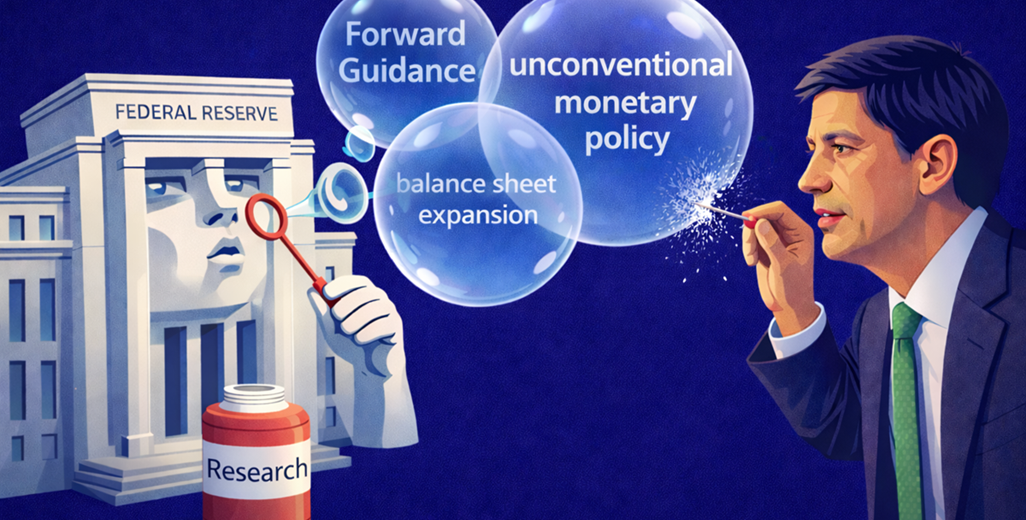
COMMENT. A potential leadership change at the Fed toward Kevin Warsh could fundamentally alter not only monetary policy but also the dominant paradigm in central bank research.
1. Leadership Change at the Fed
Kevin Warsh is expected to take over as Chair of the Federal Reserve starting May 15, 2026. His appointment would place at the head of the world’s most powerful central bank not only a critic of the Fed’s unconventional monetary policy, but also an opponent of the theories and methods that have shaped central bank research and policymaking in recent decades. Both Kevin Warsh and U.S. Treasury Secretary Scott Bessent have criticized the Fed for moving away from traditional interest rate policy and increasingly conducting monetary policy through its balance sheet (Warsh, 2016a; Bessent, 2025). In doing so, they argue, it has overreached its mandate and pursued redistributive policies. Since the Federal Reserve issues not only the world’s reserve currency but also the most influential research apparatus among central banks, a leadership change at the Fed could also bring about shifts in monetary policy research.
2. Historical Development
Shortly after the Fed’s founding in 1913, research departments were established, such as the Division of Research and Statistics in 1923. These were intended to provide statistical information as a basis for monetary policy decisions (Binder and Skinner, 2022). Since the 1960s, the regional Federal Reserve Banks have not only provided data but have also increasingly contributed ideas on the design of monetary policy to the Fed system. For example, economists at the Federal Reserve Bank of Minneapolis were involved in the development of the theory of rational expectations (see Bordo and Prescott, 2023). Based on this contribution, the New Keynesian DSGE models later emerged as the standard methodology in macroeconomics. Since the money supply no longer plays a central role in explaining inflation in these models, money supply control lost importance in monetary policy decisions in favor of direct inflation control (inflation targeting). The focus of monetary policy therefore shifted to model-based, non-observable variables such as inflation expectations, the output gap, and the natural interest rate, which expanded the central bank’s discretionary scope for action.
At the same time, the Fed expanded its role as a producer of academic publications. In the top 200 economics journals most frequently cited by central banks, according to the Bank for International Settlements, the Fed has steadily increased the number of its publications since the 1990s (see Figure 1). Over the past 30 years, publications including authors from the Federal Reserve System have accounted for a relatively constant 6 percent of global publications in the field of macroeconomics and monetary economics. This means that about one-third of publications including central bank authors originate from the Federal Reserve System (see Figure 2).

In addition, the Fed established its own conferences where it presented and organized discussions on selected academic papers. Since 1978, the Jackson Hole Symposium of the Federal Reserve Bank of Kansas City has served as a central platform for monetary policy debates. This format not only facilitates professional exchange but also helps set the agenda and raise the visibility of certain research approaches over others. Starting in the 2000s, the Jackson Hole Symposium increasingly addressed the limits of traditional interest rate control. In his opening remarks in 2010 and 2012, among other occasions, Fed Chair Ben Bernanke described the use of unconventional measures—such as balance sheet expansion through securities purchases—in the face of low interest rates as theoretically consistent extensions of monetary policy (Bernanke, 2010; Bernanke, 2012). In this way, the transition from a primarily interest-rate-based monetary policy to interventions in financial markets through extensive asset purchases was accompanied by academic research.

3. The Fed as a Trendsetter
The Fed’s influence on academic research is evident in the number of citations of academic papers with at least one Fed author. Publications by Fed authors receive approximately 7,000 citations annually (see Figure 3), which accounts for about 40 percent of all citations of papers with at least one central bank author. Cited authors, in turn, can help decide on the publication of other academic papers through the peer-review process standard in academia.
Some Fed economists also serve on the editorial boards of major academic journals. At the Journal of Monetary Economics—one of the leading journals in the field of monetary policy—4 out of 34 co-editors currently have an affiliation with the Fed. At the American Economic Journal: Macroeconomics, 7 out of 24 co-editors have a Fed affiliation. Since 2005, the major central banks have even created their own journal for central bank research, the International Journal of Central Banking. Fed economists thus act as gatekeepers who help determine the selection, evaluation, and visibility of research and can thereby shape the academic discourse on monetary policy.
As early as 2005, Lawrence White described the Federal Reserve as a dominant player in monetary policy research (White, 2005). According to his data, the Federal Reserve System employed around 495 full-time economists at the time, 220 of whom were at the Board of Governors. Today, more than 400 economists with PhDs work at the Board of Governors alone. In addition, the Fed engages external researchers as visiting scholars and consultants, and organizes conferences where academics present alongside Fed economists. According to White, the Fed is thus not merely a participant but a central driver of the monetary policy debate. White argued that this arrangement carries the risk that monetary policy paradigms will be entrenched by institutional resources.

4. The Formation of Monetary Policy Paradigms
Ideally, the scientific basis for monetary policy decisions emerges outside the institution, through open competition among different theoretical schools of thought and empirical methods. The central bank’s role would be to review this research impartially and translate it into policy decisions. If a significant portion of academic career paths, publication opportunities, and research resources are directly or indirectly intertwined with the central bank, an environment emerges in which certain theories and methods are systematically favored by central banks. Central bank economists may be tempted to legitimize monetary policy mistakes through academic publications in order to reap career benefits. Criticism of central banks may be pushed out of the academic sphere.
For example, Ben Bernanke, who later became Fed Chair, argued in 2005 that a global savings glut was a major cause of low long-term real interest rates in the U.S. (Bernanke, 2005). With this explanation, he attributed the Fed’s low interest rates and their negative side effects to factors beyond the Fed’s control.1 Empirical evidence was provided in 2015 by a paper by Laubach and Williams, which demonstrated a significant decline in the natural real interest rate due to demographics. John Williams was president of the San Francisco Fed at the time and is now president of the Federal Reserve Bank of New York. Kevin Warsh and U.S. Treasury Secretary Scott Bessent, on the other hand, view asset price inflation, growing inequality, and distorted political incentives as direct consequences of the Fed’s cheap money policy, which the Fed has failed to research for decades.
Fabo et al. (2021) examine 54 studies on quantitative easing in the U.S., the United Kingdom, and the euro area and show that authors affiliated with central banks, on average, assess the macroeconomic effects of asset purchase programs more favorably than independent researchers. According to Fabo et al. (2021), studies close to central banks report larger effects on output and price levels and, in particular, more frequently find statistically significant effects regarding the growth impacts of monetary policy. Asset price bubbles, misallocations, or long-term risks to the central bank’s balance sheet, however, are given less consideration.

The Fed’s forecasting errors can be interpreted as a consequence of flawed models and assumptions. In December 2021, the Fed projected inflation of 2.6 percent for 2022 and 2.3 percent for 2023. The actual inflation rates ultimately stood at 8 percent and 4.1 percent, respectively. Although inflation had already risen to nearly 7 percent by November 2021, the Fed decided to keep interest rates near zero because, based on its models, it assessed inflation as temporary (Federal Reserve, 2021). It did not react until inflation had reached nearly 8 percent in March 2022 (see Figure 4). Meanwhile, the Fed’s balance sheet had risen from $4.2 trillion in March 2020 to nearly $9.0 trillion in April 2022. The repeated reliance on models that systematically underestimate inflationary pressures suggests that certain assumptions within central bank research have not been sufficiently scrutinized.
5. The Future of the Fed and the Future of Fed Research
As early as 2016, Kevin Warsh described the Fed as an institution whose “models are unreliable, its policies erratic and its guidance confusing.” At the same time, he criticized the “groupthink” that dominates within the Fed, through which new monetary policy dogmas are entrenched in the mainstream (Warsh, 2016b). Even then, he called for new data sources, new analytical methods, new economic models, new communication strategies, and a new mindset for monetary policy (Warsh, 2016b). The Fed had become politically vulnerable, he argued, because it had continually expanded its scope of responsibilities, while its track record and accountability had not kept pace.
U.S. Treasury Secretary Scott Bessent has nominated Kevin Warsh for the position of Fed Chair. Last year, Bessent pointedly described the Fed as a kind of “universal basic income for academic economists,” alluding to the size of its research apparatus, which, however, had not prevented the Fed from making poor decisions (CNBC, 2025). One consequence would be to place stricter limits on Fed employees’ publishing activities or even ban them entirely to prevent influence on the academic community. At the very least, the Fed’s research apparatus could be scaled back through job cuts. A new Fed chair could initiate such steps but could not implement them unilaterally. Decisions by the Board of Governors and the regional Federal Reserve Banks are required for that.
Should the Fed, under Kevin Warsh, refocus more strongly on its mandate and devote less effort to embedding its own theories in the academic mainstream, this could influence both monetary policy direction and monetary policy research. On the one hand, this would manifest in a shift away from unconventional monetary policy and a reduction of the Fed’s balance sheet. On the other hand, dominant schools of thought could lose influence, and issues that have received less attention to date could come more into focus—such as the side effects of persistently low interest rates, the long-term consequences of securities purchases, or the risks of growing fiscal dominance.
_____________________________________________________________
References:
Bernanke, B. S. (2005): The global saving glut and the U.S. current account deficit. Speech, Board of Governors of the Federal Reserve System, April 14. Available at: https://www.cnbc.com/2025/07/21/cnbc-transcript-us-treasury-secretary-scott-bessent-speaks-with-cnbcs-squawk-box-today.html.
Bernanke, B. S. (2010): Opening remarks: The economic outlook and monetary policy – Jackson Hole Economic Policy Symposium. Kansas City, MO: Federal Reserve Bank of Kansas City. Available at: https://www.kansascityfed.org/research/jackson-hole-economic-symposium/macroeconomic-challenges-decade-ahead/.
Bernanke, B. S. (2012): Opening remarks: Monetary policy since the onset of the crisis – Jackson Hole Economic Policy Symposium. Kansas City, MO: Federal Reserve Bank of Kansas City. Available at: The Changing Policy Landscape - Federal Reserve Bank of Kansas City.
Bessent, S. (2025): The Fed’s New “Gain-of-Function” Monetary Policy. The International Economy. Available at: http://www.international-economy.com/TIE_Sp25_Bessent.pdf .
Binder, C. and Parajon Skinner, C. (2022): Mission critical or mission creep? The research function of the Federal Reserve Banks. Mercatus Policy Brief. Arlington, VA: Mercatus Center. Available at: https://www.mercatus.org/research/policy-briefs/mission-critical-or-mission-creep-research-function-federal-reserve-banks.
Bordo, M. D. and Prescott, E. S. (2023): Federal Reserve structure and the production of monetary policy ideas. NBER Working Paper, No. 31915. Cambridge, MA: National Bureau of Economic Research. Available at:https://www.nber.org/papers/w31915 .
CNBC (2025): CNBC transcript: U.S. Treasury Secretary Scott Bessent speaks with CNBC’s Squawk Box. July 21. Available at: https://www.cnbc.com/2025/07/21/cnbc-transcript-us-treasury-secretary-scott-bessent-speaks-with-cnbcs-squawk-box-today.html.
Fabo, B., Jančoková, M., Kempf, E., and Pástor, Ľ. (2021): Fifty shades of QE: Comparing findings of central bankers and academics. Journal of Monetary Economics, 120, pp. 1–20.
Federal Reserve (2021): Federal Reserve issues FOMC statement. November 3. Available at: https://www.federalreserve.gov/newsevents/pressreleases/monetary20211103a.htm.
Laubach, T. and Williams, J. C. (2015): Measuring the natural rate of interest redux. Federal Reserve Bank of San Francisco Working Paper No. 2015-16. San Francisco, CA: Federal Reserve Bank of San Francisco. Available at: http://www.frbsf.org/economic-research/publications/working-papers/wp2015-16.pdf.
Mayer, T. and Schnabl, G. (2021): Reasons for the demise of interest: Savings glut and secular stagnation or central bank policy?. Quarterly Journal of Austrian Economics, 24(1), pp. 3–40. Available at: https://doi.org/10.35297/qjae.010085.
Warsh, K. (2016a): Challenging the groupthink of the guild. Stanford, CA: Hoover Institution, March 8. Available at: https://www.hoover.org/research/challenging-groupthink-guild-0.
Warsh, K. (2016b): The Federal Reserve needs new thinking. Stanford, CA: Hoover Institution, August 24. Available at: https://www.hoover.org/research/federal-reserve-needs-new-thinking.
White, L. H. (2005): The Federal Reserve System’s influence on research in monetary economics. Econ Journal Watch, 2(2), pp. 325–354. Available at: https://econjwatch.org/file_download/90/2005-08-white-invest_apparatus.pdf.
__________________________________________
1 Mayer and Schnabl (2021) show that persistently low interest rates were caused less by global savings surpluses than by years of expansionary monetary policy by central banks. Repeated interest rate cuts and unconventional measures have distorted market-based capital allocation, thereby slowing growth and increasing inequality. Accordingly, low interest rates are not the result of exogenous factors, but rather the consequence of monetary policy decisions.

About the author
Research analyst and research assistant for economic policy at the University of Leipzig. Adam Smith and Carl Menger Fellow at the Mercatus Centre. Studied economics in Leipzig and Paris.



Legal notice
The information contained and opinions expressed in this document reflect the views of the author at the time of publication and are subject to change without prior notice. Forward-looking statements reflect the judgement and future expectations of the author. The opinions and expectations found in this document may differ from estimations found in other documents of Flossbach von Storch SE. The above information is provided for informational purposes only and without any obligation, whether contractual or otherwise. This document does not constitute an offer to sell, purchase or subscribe to securities or other assets. The information and estimates contained herein do not constitute investment advice or any other form of recommendation. All information has been compiled with care. However, no guarantee is given as to the accuracy and completeness of information and no liability is accepted. Past performance is not a reliable indicator of future performance. All authorial rights and other rights, titles and claims (including copyrights, brands, patents, intellectual property rights and other rights) to, for and from all the information in this publication are subject, without restriction, to the applicable provisions and property rights of the registered owners. You do not acquire any rights to the contents. Copyright for contents created and published by Flossbach von Storch SE remains solely with Flossbach von Storch SE. Such content may not be reproduced or used in full or in part without the written approval of Flossbach von Storch SE.
Reprinting or making the content publicly available – in particular by including it in third-party websites – together with reproduction on data storage devices of any kind requires the prior written consent of Flossbach von Storch SE.
© 2024 Flossbach von Storch. All rights reserved.